Celica Real vs Miniature Comparison
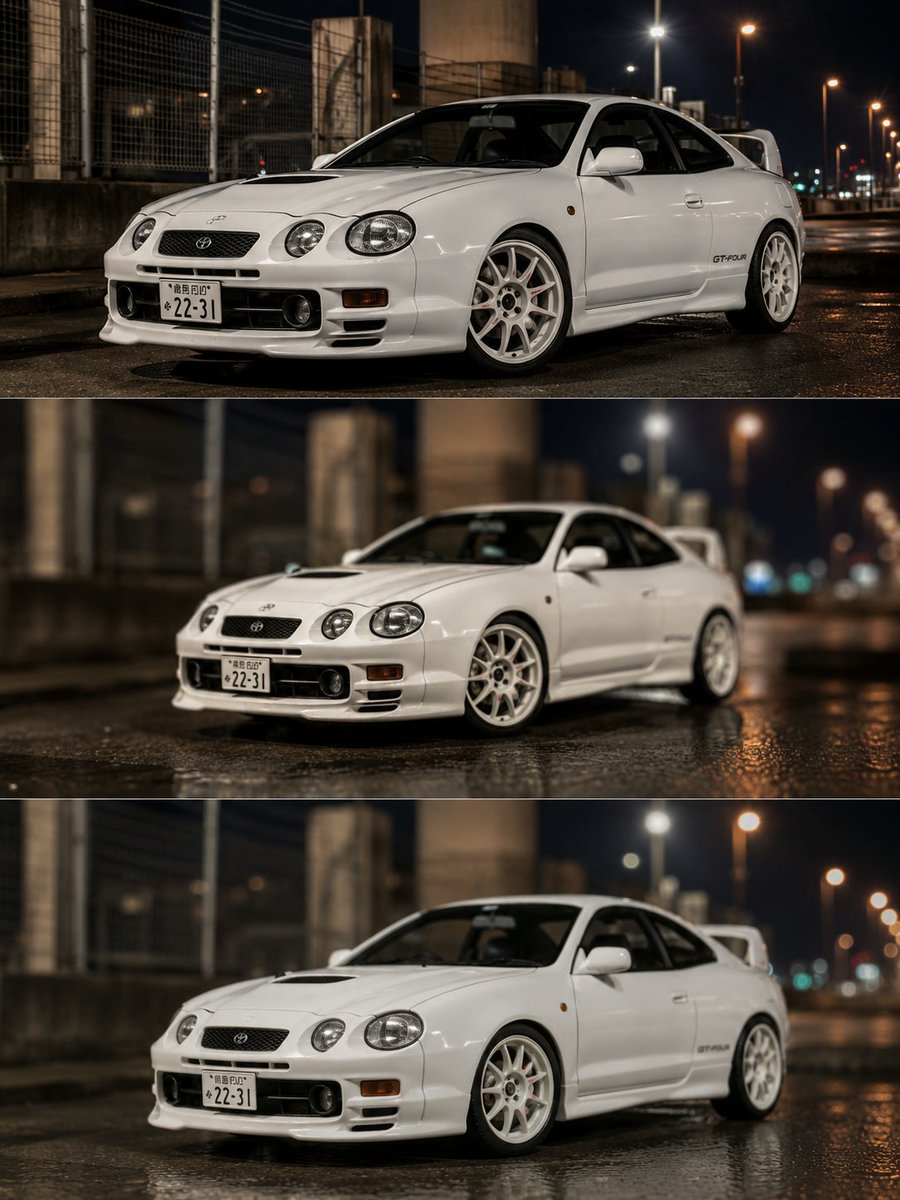
Generates a three-panel photorealistic comparison of a white Toyota Celica GT-Four as a real car, a miniature-looking real car, and a realistic plastic model.
مثال مولَّد
Prompt
Goal: Create a vertical comparison image showing the same white Toyota Celica GT-Four in three stacked photographic panels, comparing three realism styles: a real car, a real car photographed to look like a miniature, and a plastic model photographed to look like a real car. Canvas: Portrait 3:4 composition, 768 × 1024 style, divided into exactly 3 equal horizontal panels separated by thin white divider lines. No captions or overlay text outside the car details. Subject: A {argument name="car model" default="white Toyota Celica GT-Four ST205"} shown from a front-left three-quarter angle, low stance, white multi-spoke wheels, large rear wing, hood vent, round twin headlamps, front bumper fog lights, side decal reading “GT-FOUR,” and a Japanese license plate with the visible number {argument name="license plate number" default="22-31"}. The car should remain visually consistent across all three panels. Setting: Nighttime urban industrial road scene in {argument name="location style" default="Japan"}, wet asphalt after rain, reflective puddles, concrete pillars, chain-link fencing, bridge or elevated roadway structures, and warm streetlights receding into the background with bokeh. Panel 1: Top panel shows the real full-size car photographed naturally. Sharp, realistic automotive photography, crisp body details, accurate proportions, deep reflections on wet pavement, moderate background blur, cinematic night lighting. Panel 2: Middle panel shows the same real car but photographed to look miniature. Use tilt-shift depth of field, stronger blur at foreground and background, slightly toy-like scale illusion, softened details, shiny wet road reflections, and a more diorama-like feel while still using the same viewpoint. Panel 3: Bottom panel shows a plastic scale model of the same car photographed to look like a real full-size car. Keep the car highly realistic but subtly model-like in the surface finish and fine details; use shallow depth of field, realistic reflections, convincing low-angle automotive composition, and the same wet night street environment. Visual style: High-quality photorealistic comparison, cinematic contrast, glossy white paint, warm orange and cool blue night tones, realistic lens bokeh, no people, no extra vehicles, no logos or watermarks. Maintain exactly 3 panels and exactly 1 car per panel.