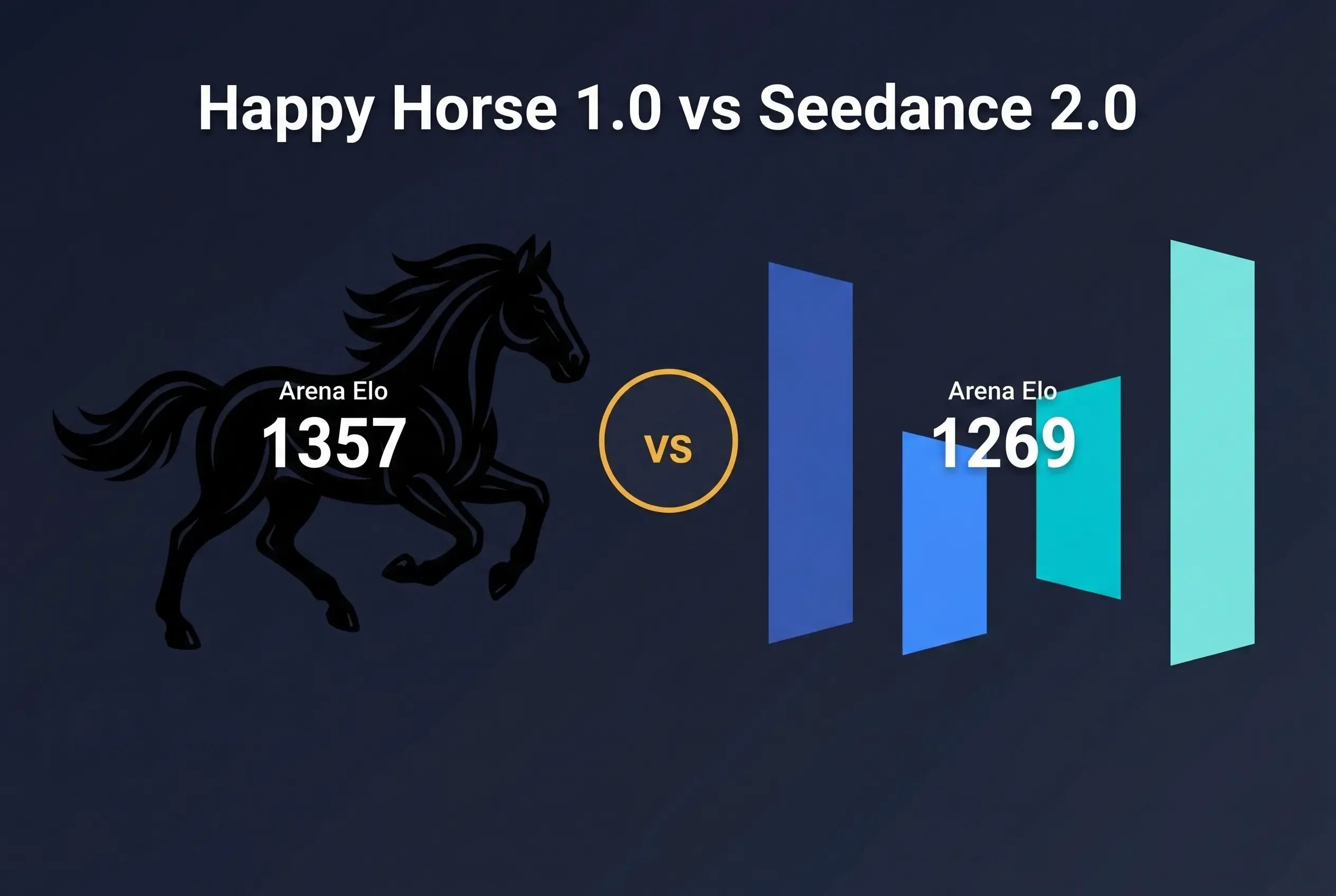

On April 7, 2026, a mysterious video model called Happy Horse 1.0 quietly landed on the Artificial Analysis Video Arena and knocked the previous champion, Seedance 2.0, off the throne. One is a stealth release from Alibaba with very little public information; the other is ByteDance's "director-grade" production tool, officially launched in March 2026. Which one should you actually use today?
What you'll learn: the real gap between Happy Horse 1.0 and Seedance 2.0, which model to pick in different scenarios, and how to ship projects with Seedance 2.0 today while waiting for Happy Horse to open up.
Run both on one platform with Topview. Instead of juggling Dreamina, CapCut, fal.ai and separate API keys, you can access every mainstream video model — including Seedance 2.0, Veo, Sora 2, Kling, Wan, Vidu Q3 and more — through a single toolkit at Topview AI. Generate, edit, and collaborate in one place, and swap to Happy Horse the moment it opens up without changing your workflow. Try Topview free →
Quick Summary: The Core Differences at a Glance
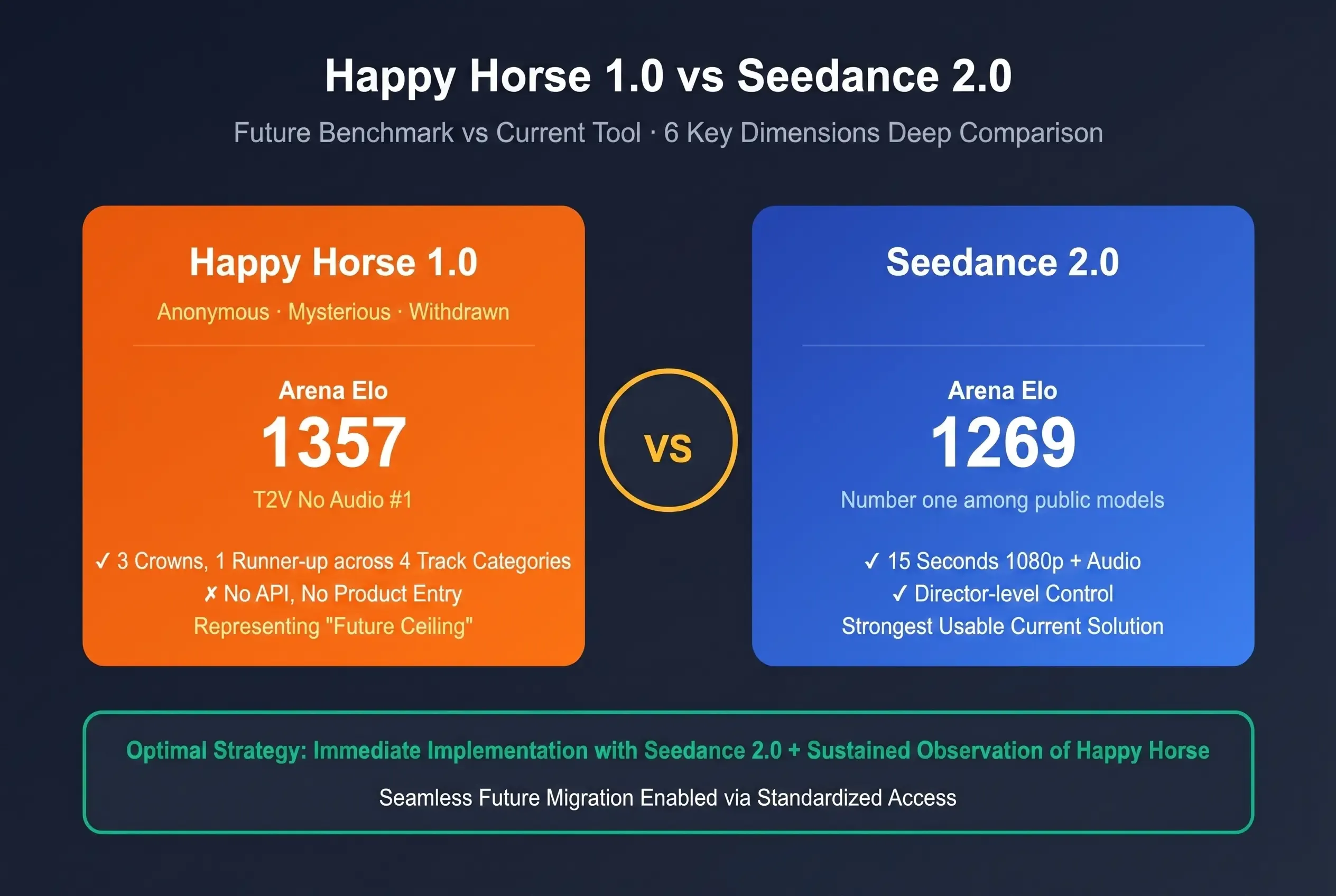
Let's put the conclusion up front: Happy Horse 1.0 leads on the Elo leaderboard, but Seedance 2.0 is the only truly usable option today. Happy Horse appeared in the Arena for only 72 hours and then vanished — no API, no product entry point, no public release. Seedance 2.0 is already stable and available on Dreamina, CapCut, and fal.ai.
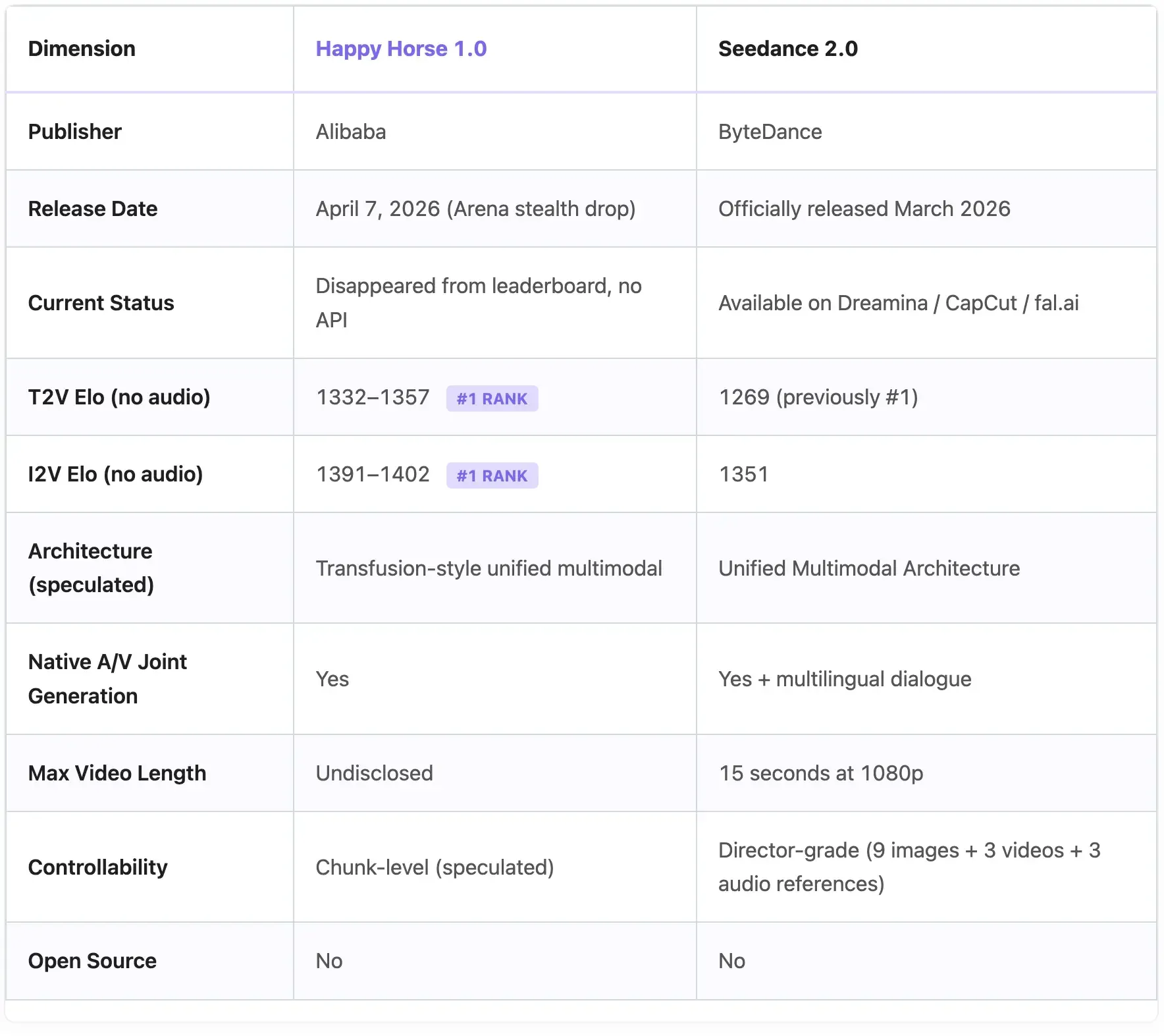
Quick takeaway: If you need to ship a project today, choose Seedance 2.0 without hesitation. If you're researching model capabilities and want to understand the current ceiling of video generation, keep an eye on Happy Horse's upcoming official release.
Detailed Comparison
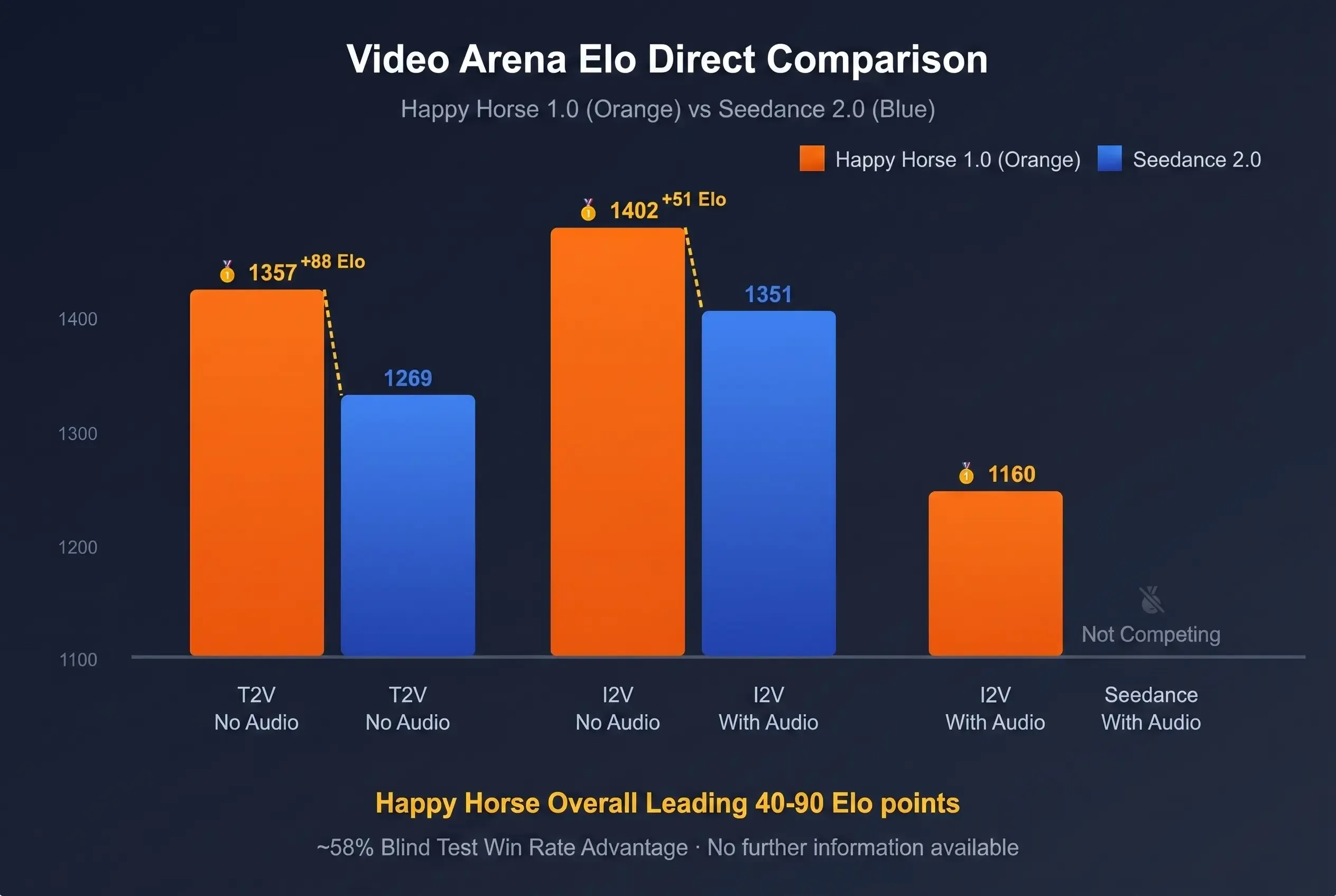
Difference 1: Elo Performance — Happy Horse Leads by 60+ Points Across the Board
The Artificial Analysis Video Arena is currently the most authoritative blind-test leaderboard for AI video generation, based on real user blind voting and Elo scoring.
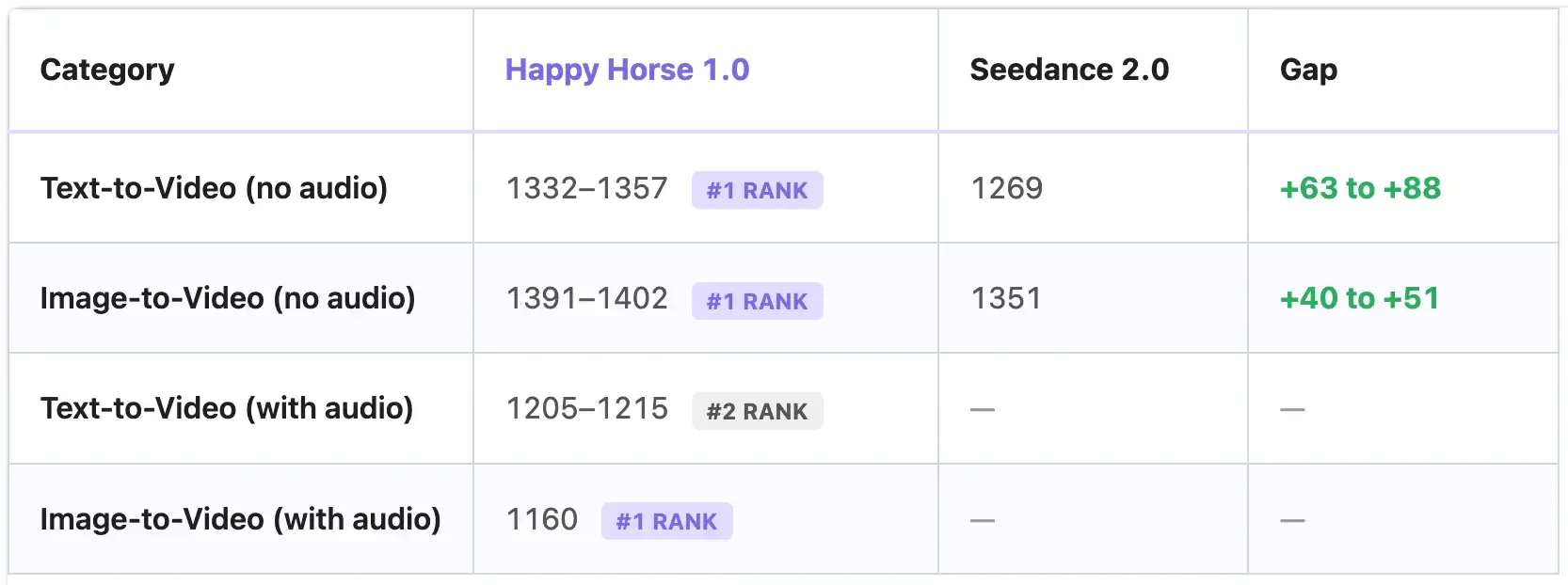
Under the Elo system, a 60-point lead is roughly equivalent to a 58% blind-test win rate. Happy Horse's lead in the T2V no-audio track is already approaching a "generational gap." That said:
When Seedance 2.0 debuted in March 2026 at 1269, it beat Google Veo 3, OpenAI Sora 2, and Runway Gen-4.5.
Seedance 2.0 is still the #1 publicly available model.
Happy Horse is currently a non-public model — leading in theory is not the same as leading in practice.
Difference 2: Availability — Seedance 2.0 Wins Decisively
This is the biggest gap between the two, and the one 90% of users should actually care about.
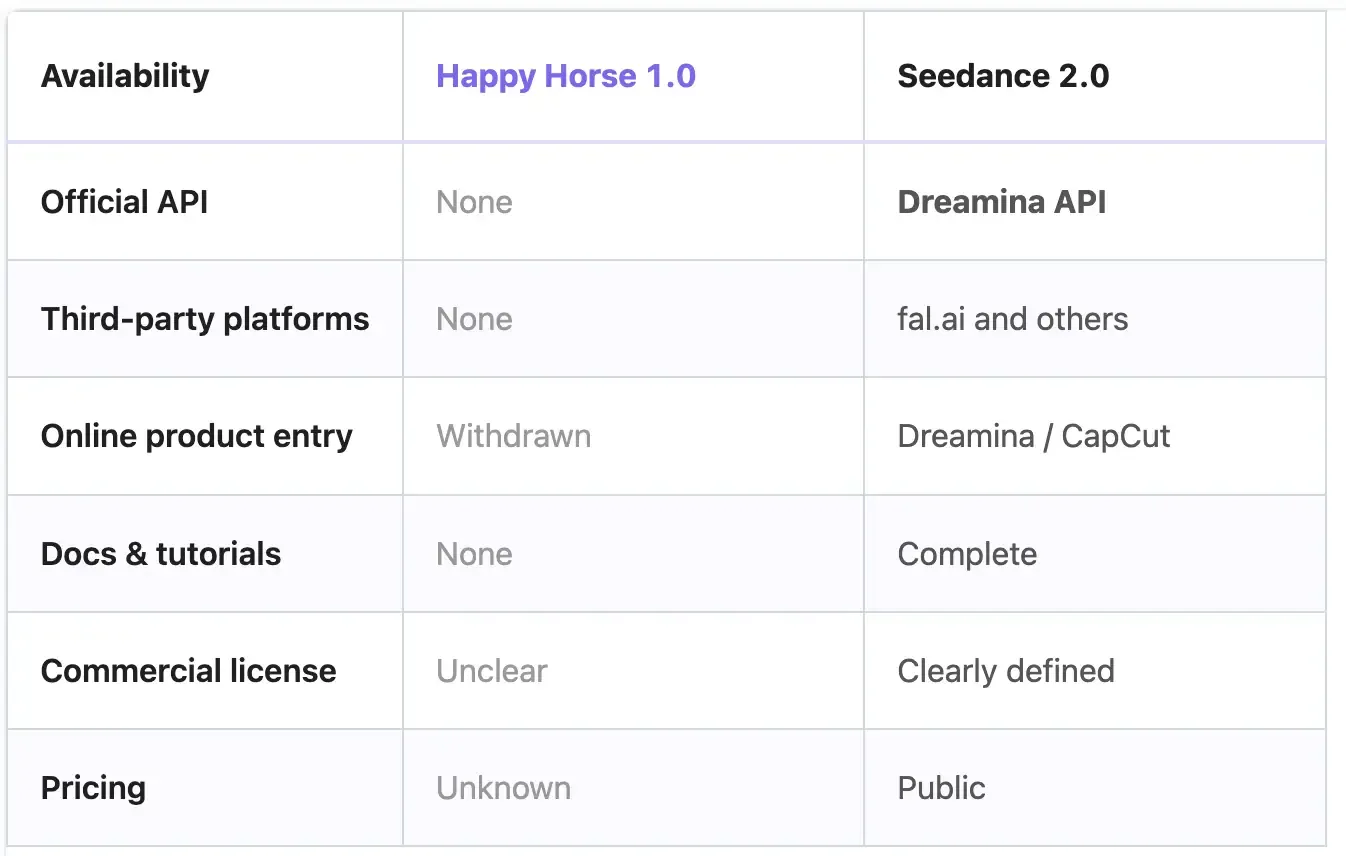
Happy Horse 1.0 appeared on Artificial Analysis for just 72 hours before vanishing. There is still no API, no product entry, no GitHub repo, and no Hugging Face page. Its "first place" currently exists only in leaderboard screenshots.
Seedance 2.0, by contrast, is a released ByteDance product — stable in Dreamina and CapCut, with API access via third-party platforms. It's ready for production use today.
Difference 3: Architecture — Both "Unified Multimodal," but Different Approaches
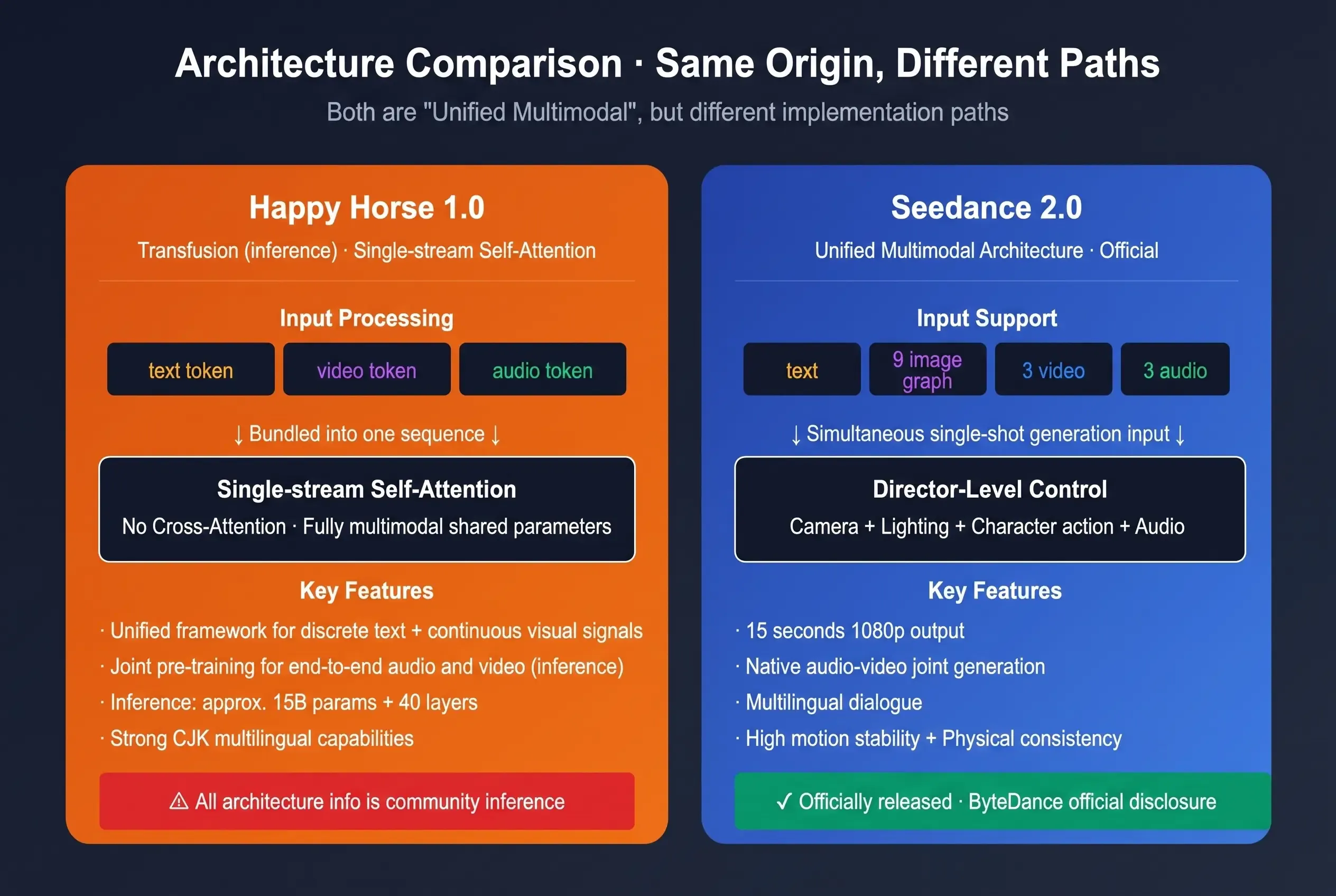
Both belong to the "unified multimodal" family, but take different paths.
Happy Horse 1.0 (speculated):
Believed to use a Transfusion-style architecture
Discrete text modeling + continuous visual signals processed jointly in one framework
Single-stream self-attention, no cross-attention
Text / video / audio tokens packed into the same sequence for joint denoising
Seedance 2.0 (officially disclosed):
Unified Multimodal Architecture
Accepts four input types: text, image, audio, and video
Native multilingual dialogue generation
"Director-grade" control — a single generation can ingest 9 reference images + 3 video clips + 3 audio clips
Note: since Happy Horse has no public paper, all architecture details are community speculation. Seedance 2.0's architecture details are officially disclosed by ByteDance and therefore more reliable.
Difference 4: Input Control — Seedance 2.0 Is a "Director's Tool"
This is what truly sets Seedance 2.0 apart. It's not positioned as a simple "prompt → video" generator — it's positioned as a director's workstation.
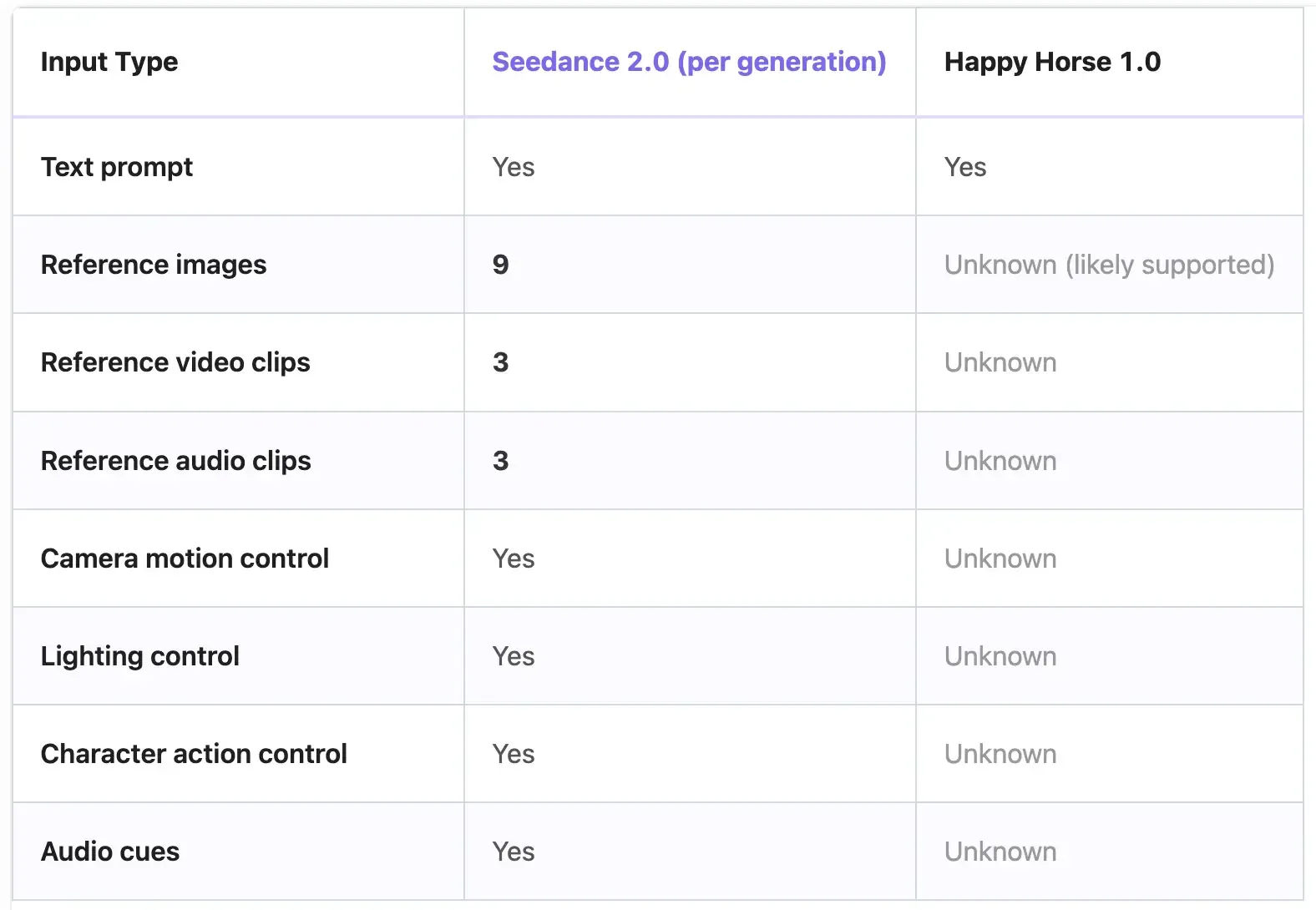
ByteDance officially describes this as "director-level control" — meaning you're no longer "describing a scene," you're "directing a shoot." This is a huge win for short-form drama, advertising, and MV creators.
Since Happy Horse 1.0 has no official documentation, all of these dimensions are currently a black box.
Difference 5: Video Length and Resolution
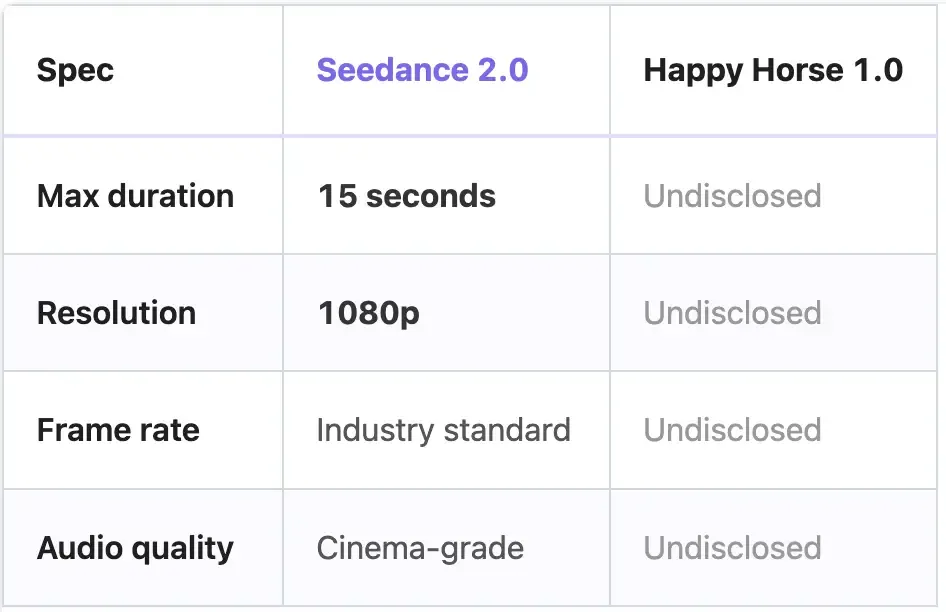
Seedance 2.0's "15 seconds at 1080p with native audio" is the most practical spec combination among today's commercial video models — essentially "good enough out of the box" for short video, advertising, and e-commerce use cases.
Difference 6: Ecosystem and Tooling
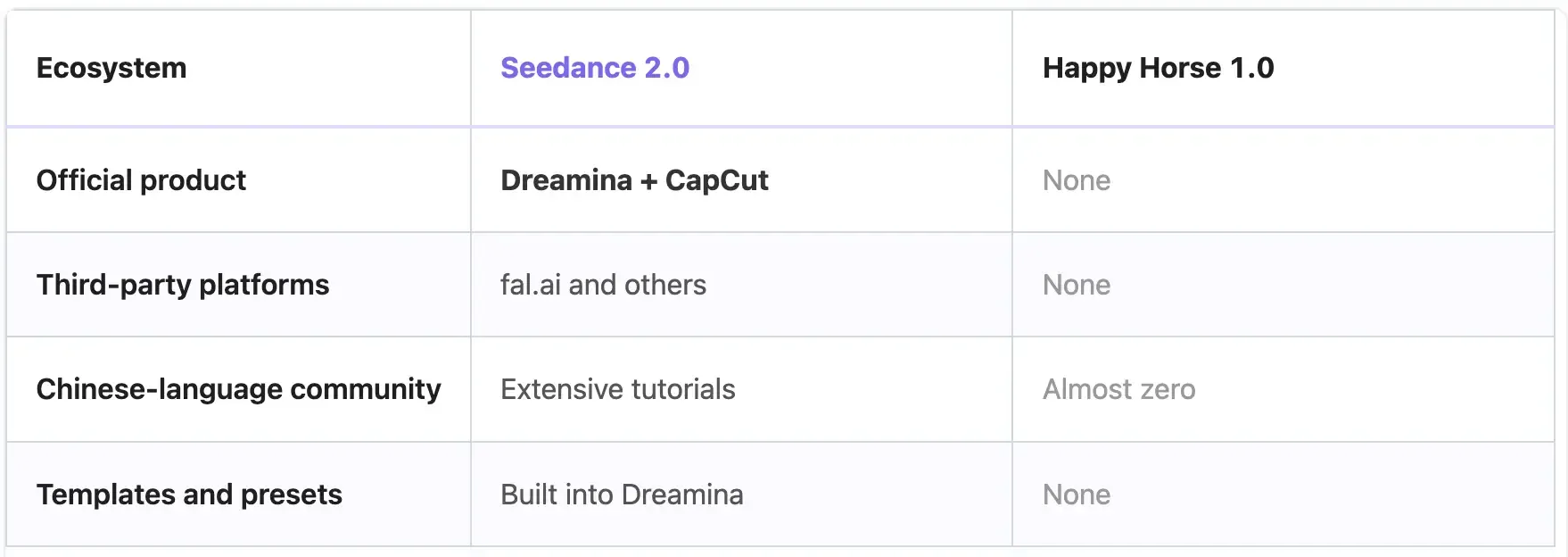
Framing: Happy Horse 1.0's biggest value right now is telling the industry where the ceiling could go. Seedance 2.0 is what you actually use to ship projects today. Treat Seedance 2.0 as your production workhorse and Happy Horse as a model to watch.
Scenario Recommendations
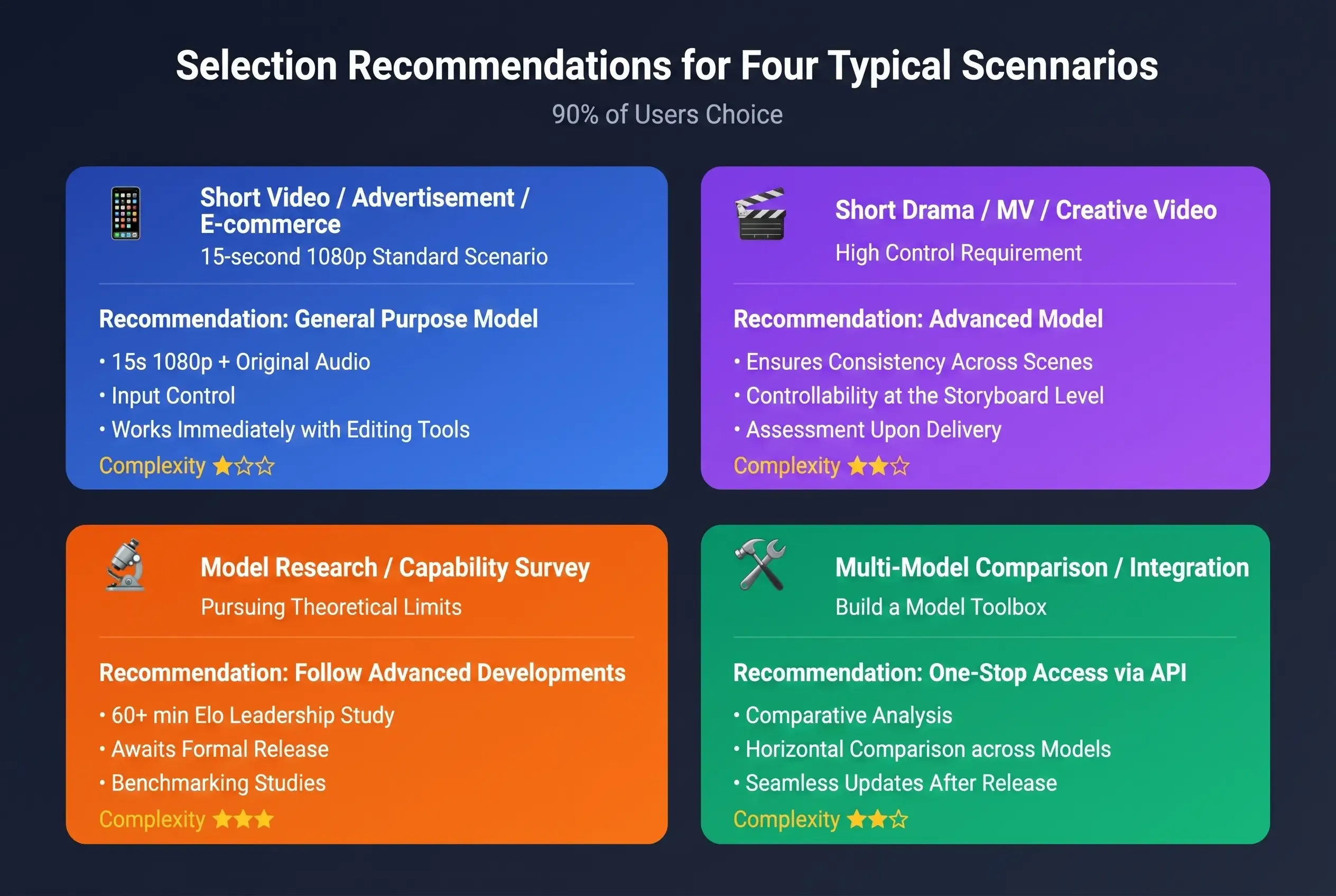
Scenario 1: Short Video / Ads / E-commerce Creative
Recommendation: Seedance 2.0
15 seconds at 1080p + native audio + director-grade input control — practically tailor-made for this use case. Dreamina and CapCut entry points are directly usable; no engineering integration required.
Scenario 2: Short Drama / MV / Creative Video
Recommendation: Seedance 2.0 (primary) + keep watching Happy Horse
Short-form drama needs "director-grade control" and "scene consistency" above all else. Seedance 2.0's 9-image + 3-video reference capability is the current best. Happy Horse leads on visual quality but isn't usable yet — worth monitoring for its official release.
Scenario 3: Model Research / Capability Ceiling Analysis
Recommendation: Track Happy Horse 1.0's release roadmap
Happy Horse's 60+ Elo lead on the Arena suggests it genuinely represents the next generation of visual quality. For researchers, Happy Horse is a must-watch — but you'll need to wait for its public release (expected within 3–8 weeks).
Scenario 4: Cross-Model Benchmarking
Recommendation: Run Seedance 2.0 + Veo 3 + Sora 2 + Wan 2.6 side by side
Any serious video-generation project should test at least 3–5 model families to pick the right fit for its specific scenarios. Happy Horse is temporarily out of the running; the most pragmatic approach is to build your own "model toolbox" with the options available today and add Happy Horse as soon as it goes public.
Decision Guide (30-Second Picker)
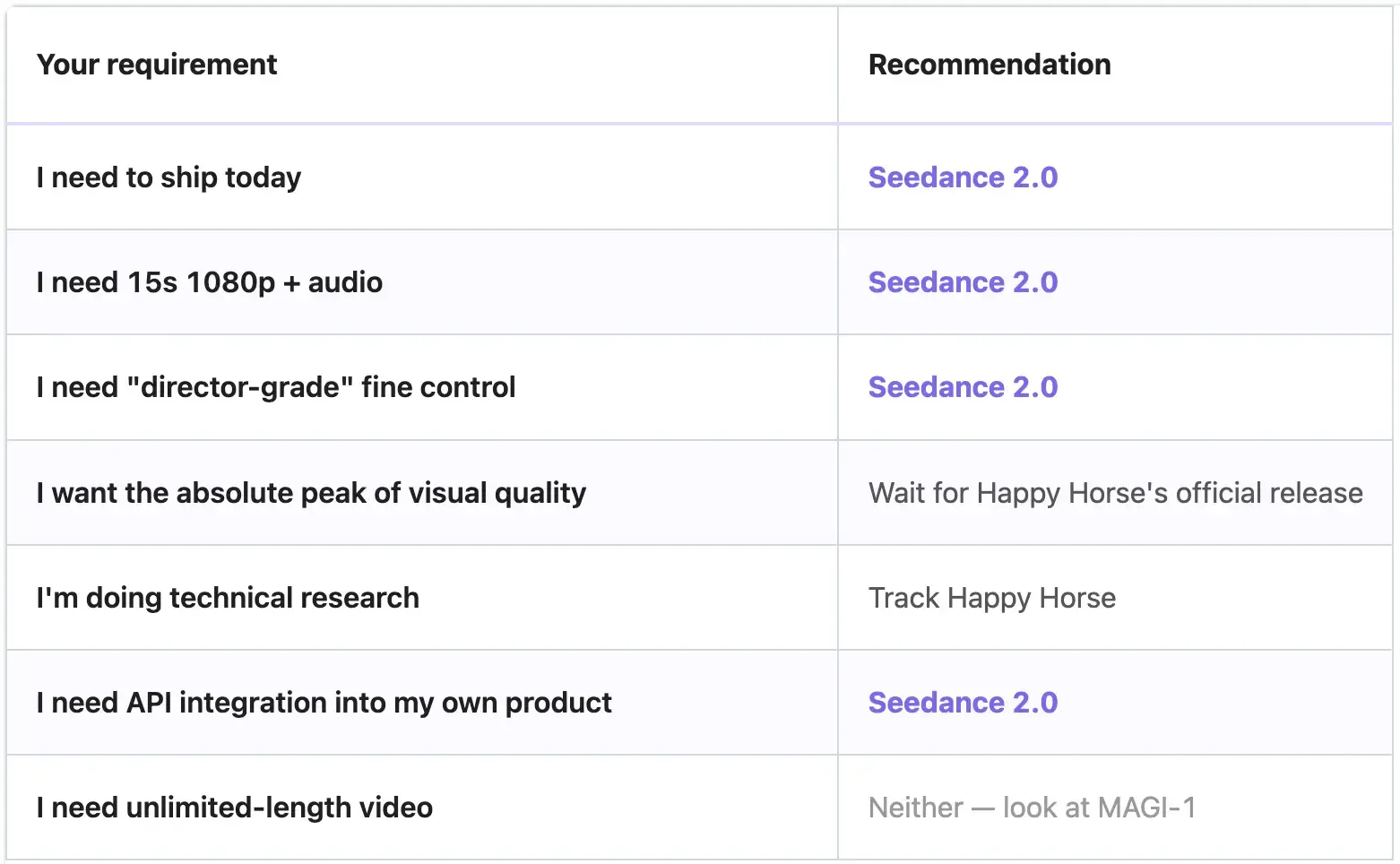
Optimal decision: 90% of real projects should choose Seedance 2.0. The remaining 10% can wait for the official Happy Horse release. These two aren't really competitors — Happy Horse is the future, Seedance 2.0 is the present.
FAQ
Q1: Is Happy Horse 1.0 really that much better than Seedance 2.0?
On the Artificial Analysis Video Arena's blind-test Elo, Happy Horse 1.0 leads Seedance 2.0 by roughly 60–90 points in the T2V no-audio track, which translates to about a 58% blind-test win rate — a genuinely significant lead. But keep three things in mind: (1) Elo is a single-dimensional overall preference score and may not reflect your specific use case; (2) Happy Horse has no product or API, so its "lead" currently lives only on screen; (3) Seedance 2.0 has a unique advantage in "director-grade control," which the Arena doesn't measure.
Q2: When will Happy Horse 1.0 be available?
Unknown. It dropped into the Arena on April 7, disappeared 72 hours later, and there's still no official timeline. Based on the release patterns of similar stealth models in the past (early variants of GPT-4 Turbo and Claude 3.5 Sonnet on LMArena), a formal product release typically comes within 3–8 weeks. Until then, there's no usable entry point.
Q3: Can Seedance 2.0 be used in China?
Yes. Seedance 2.0 is a ByteDance product and natively supports Chinese inputs via Dreamina and CapCut. For API integration, it can also be accessed via third-party platforms.
Q4: Should I wait for Happy Horse before starting my video project?
No. Two reasons: (1) when Happy Horse goes public is a black box — it could be 3 weeks or 3 months; (2) the engineering pipeline around video generation (prompt engineering, reference image prep, post-processing) is decoupled from the model itself. The workflow you build on Seedance 2.0 today will transfer almost seamlessly to Happy Horse later. The optimal strategy is to start with Seedance 2.0 now and switch as needed.
Q5: Do both models support Chinese prompts?
Seedance 2.0 natively supports Chinese prompts and understands Chinese scenes well — a natural advantage of a ByteDance model. Happy Horse 1.0's Chinese support can't be verified without a public API, but given that its publisher Alibaba has deep multilingual capabilities, strong Chinese support is expected.
Q6: How do I deliver a 30-second ad with Seedance 2.0 today?
The most pragmatic approach: (1) split the 30 seconds into two 15-second segments and generate each with Seedance 2.0 (using its 15-second max); (2) prepare 9 reference images and 3 reference videos per segment to maintain scene consistency using director-grade control; (3) stitch and transition them in CapCut during post. If you want to push visual quality even further, run Veo 3 / Sora 2 in parallel and pick the best output.
Conclusion
The Happy Horse 1.0 vs. Seedance 2.0 comparison is essentially a conversation between "the future benchmark" and "the tool of the present."
Two key facts:
Happy Horse 1.0 genuinely represents the next generation of visual quality — a 60+ Elo lead isn't a fluke, and it shows the ceiling of AI video generation still has room to grow. With Alibaba behind it, a polished official release can be expected when it finally opens up.
Seedance 2.0 is the only top-tier option that's usable, accessible, and worth deploying today — 15 seconds at 1080p, native audio, and director-grade control, with no viable commercial substitute.
Optimal strategy:
Production work: Start shipping with Seedance 2.0 now and build up your workflow.
Keep watching: Re-evaluate migration the moment Happy Horse is officially released.
Run comparisons: Keep a "model toolbox" with Seedance 2.0 + Veo 3 + Sora 2 + Kling 2 + Wan 2.6 running in parallel.