Topview T1: narrazione cinematografica e tariffa 1080p prevedibile
Generazione in 1080p alla tariffa pubblicata di 2.2 crediti/s per tutti i membri, con input di testo, immagine e multimodale.
Quale modello video AI ti conviene?
Seedance 2.5 e Topview T1 generano clip video AI fino a 30 secondi, con output 1080p, audio nativo e fino a 50 risorse di riferimento multimodali nei flussi Topview supportati. Topview T1 è pensato per la narrazione cinematografica e pubblica una tariffa di produzione 1080p di 2.2 crediti al secondo per ogni membro. Seedance 2.5 aggiunge opzioni di flusso, tra cui un Draft Mode dedicato a 480p, e costa 3.7 crediti al secondo per l’output 1080p.
Guarda come trattano l’interpretazione drammatica, le scene con dialogo, i video musicali, l’azione fantasy e gli effetti visivi. Confronta il risultato creativo, ciò che chiede ogni flusso e il preventivo reale in crediti prima di decidere.
Topview T1: narrazione cinematografica e tariffa 1080p prevedibile
Generazione in 1080p alla tariffa pubblicata di 2.2 crediti/s per tutti i membri, con input di testo, immagine e multimodale.
Seedance 2.5: controlli di generazione più specializzati
Output da 4 a 30 secondi, Draft Mode a 480p, regia temporale dettagliata e flussi di produzione assistiti dalla ricerca, se sono supportati.
Entrambi i modelli reggono racconti audiovisivi più lunghi e set di riferimenti ampi. Le differenze pratiche stanno nei livelli di output, in alcuni modi di generazione e nel modo in cui si paga ogni nuovo giro.
| Voce | Topview T1 | Seedance 2.5 |
|---|---|---|
| Sviluppatore / fornitore | Primo modello di generazione video di Topview | ByteDance |
| Durata massima del clip | 30 secondi | 30 secondi |
| Impostazioni di durata | 4–30 s; Smart Duration nei modi API supportati | 4–30 s; Smart Duration nei modi API supportati |
| Risoluzione di output | 720p, 1080p | 480p, 720p, 1080p |
| Da testo a video | Sì | Sì |
| Da immagine a video | Sì | Sì |
| Riferimenti multipli | Sì | Sì |
| Massimo totale di riferimenti | Fino a 50 | Fino a 50 |
| Riferimenti immagine | Fino a 30 | Fino a 30 |
| Riferimenti video | Fino a 10 | Fino a 10 |
| Riferimenti audio | Fino a 10 | Fino a 10 |
| Audio nativo | Disponibile | Disponibile |
| Proporzioni | Orizzontale, verticale, quadrato e preset adattivi supportati | Orizzontale, verticale, quadrato e preset adattivi supportati |
| Draft Mode a 480p | Non supportato | Supportato |
| Prezzo in 1080p | Tariffa pubblicata di 2.2 crediti/s per tutti i membri | Dipende dal flusso, dal piano e dal preventivo in tempo reale; 3.7 crediti/s per gli utenti normali |
| Buon punto di partenza | Budget di produzione in 1080p e creazione guidata dalla storia | Controlli specializzati e flussi che partono da una bozza |
Le specifiche riflettono i flussi Topview pubblicati. Non garantiscono che ogni opzione compaia in ogni account. Il numero di riferimenti dipende dal tipo di file, dalla durata e dai limiti del modo.
Controlla nel generatore le scelte attuali prima di inviare.
Tutti e due possono chiudere una scena audiovisiva di 30 secondi. Scegli in base al vincolo che pesa di più: il prezzo di un’altra ripresa, il flusso di input o quanto controllo ti serve.
Topview pubblica una tariffa di 2.2 crediti/s in 1080p per T1 sui piani membri. Stima inquadrature, durata del clip e ripetizioni prima di produrre, poi conferma la tariffa che compare nel tuo account.
Prova altre interpretazioni, altri angoli e altri accenti emotivi senza chiuderti su una sola lettura. Topview T1 è orientato a corti drammatici, scene cinematografiche, animazione e video musicali in cui più riprese possono servire.
Parti da un prompt, dall’immagine del primo fotogramma o da file multimodali supportati. T1 accetta fino a 50 elementi di riferimento entro i limiti documentati di input e di durata.
Genera la scena con immagine e suono nativo insieme. Controlla voci, effetti, il tempo della musica e il movimento delle labbra nell’esportazione originale prima di usarla in un progetto finito.
Usa il Draft Mode supportato per provare una direzione prima di impegnarti in una resa finale a risoluzione più alta. Un video 480p normale e un’attività in Draft Mode a 480p non vengono necessariamente addebitati allo stesso modo.
Spezza una scheda di 30 secondi in intervalli previsti per azioni, dialogo, movimento di camera e suono. Controlla se l’output finale segue quella sequenza, soprattutto quando l’azione è fitta.
Usa la ricerca su internet solo se il flusso di riferimenti Topview che hai scelto la supporta.
Esplora in Topview gli strumenti di storyboard, di continuazione o di montaggio a segmenti legati a Seedance. Prima di basarci il progetto, distingui quali controlli sono del modello e quali della piattaforma Topview.
Scorri otto gruppi di video già caricati, tra dramma, suspense, musica, azione fantasy ed effetti visivi. Ogni scenario isola una sfida diversa: recitazione, continuità, identità, movimento, suono o lettura dello spazio.
Specifiche del clip caricato: 30s · 16:9 · 720p · 24fps
Una studentessa affronta il bullismo in un’aula assolata. La scena passa dall’intimidazione di gruppo e dai primi piani tesi al movimento nell’aula e a un momento di resistenza.
Topview T1
Seedance 2.5
Un corto drammatico funziona quando si capiscono azione ed emozione. Un volto stabile e un’interpretazione espressiva pesano più di un singolo fotogramma bello.
Seedance 2.5 rende più chiaro il finale parlato. In entrambi i clip la protagonista resta in uniforme estiva, si passa dal gruppo intorno al banco a una rissa in aula e c’è un calcio a mezz’aria con le altre a terra. Il volto resta riconoscibile in tutti e due. Seedance tiene il primo piano infastidito frontale e chiude con uno sguardo diretto e la bocca aperta, così l’avvertimento si legge come recitazione. Topview T1 mantiene anche identità e calcio, ma il primo piano finale è un profilo coperto dai capelli e l’ultima battuta si vede peggio. Durante la rissa, Topview T1 tiene il movimento più continuo e meno rigido. Scegli Seedance 2.5 quando la svolta emotiva e il finale parlato devono restare leggibili.
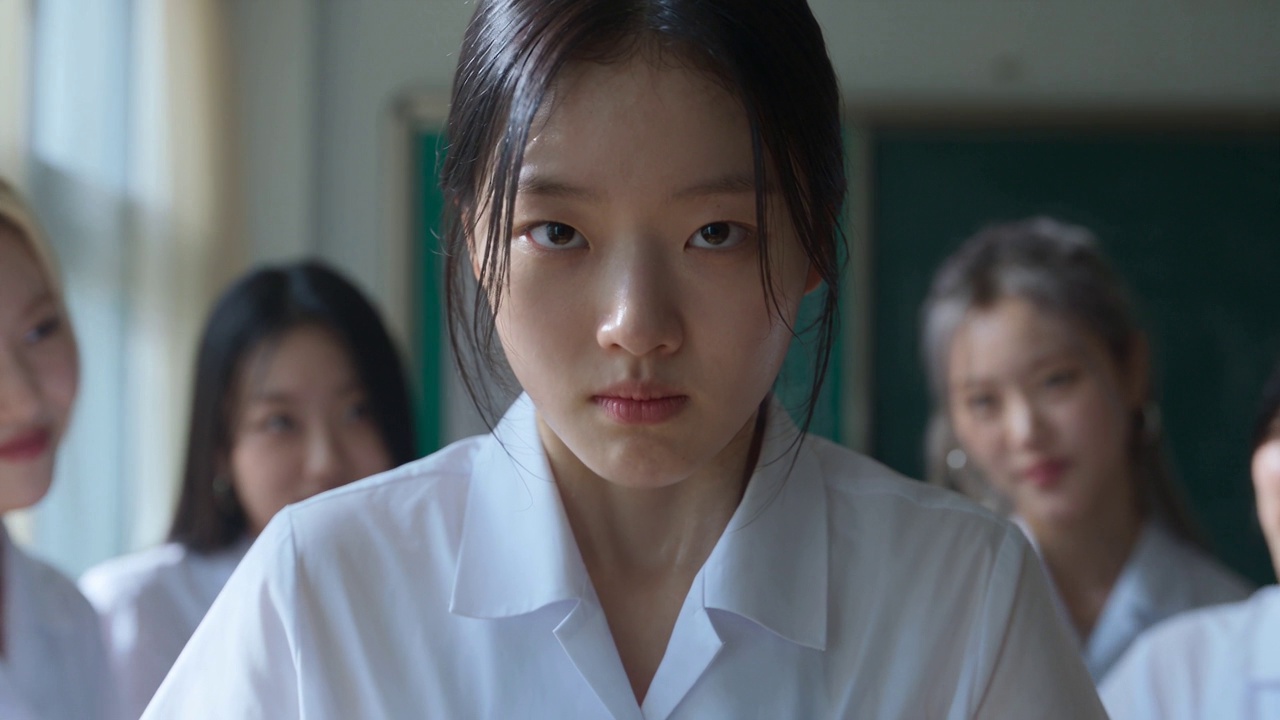
CHARACTER REFERENCE — <<<Image1>>>. Cool and elegant Korean high school girl in a summer school uniform, realistic natural skin, no beautifying filters, and a consistent face throughout. Quiet and patient but strong boundaries. Her emotion evolves from quiet tolerance to cold annoyance, a controlled outburst and a tired, disdainful aftermath. high school girl, summer school uniform, natural skin texture, no filters, consistent facial features throughout. Quiet, avoids trouble, extremely patient but with strong boundaries. Emotional shift: Zen-like patience → thoroughly annoyed by repeated harassment → calm outburst → cold disdain. Post-fight: slightly messy hair, slight panting, realistic expressions. 00:00‒00:06 | Malicious Harassment (Suppression): Quiet afternoon classroom, female lead by the window. Four bullies provoke her, bumping her desk, pushing her, throwing stationery. She avoids and stays silent, wanting peace. Wide-angle handheld camera with slight shake, oppressive atmosphere. 00:06‒00:12 | Patience Exhausted (Turning Point): Slow zoom to facial close-up. Bullies escalate. Her patience vanishes, turning into cold annoyance. She stands up straight. Background blurs, silence except for her steady breathing, preparing to end the harassment. 00:12‒00:19 | Clean Counterattack (Main Fight): Girls push her. She blocks calmly, dodges quickly. Elbow strikes, precise low kicks. Realistic, clean movements. 360° wrap-around tracking shot with camera shake and motion blur. Three bullies fall, desks slide, scene reverses. 00:19‒00:24 | Mid-air Finisher (Climax Slow-mo): Last girl rushes. Ultra-low angle shot. Lead jumps, 35% slow motion. Uniform skirt and hair flow naturally. 360-degree mid-air roundhouse kick to the chest. Opponent hits the wall. Normal frame rate upon landing, clean and powerful. All four are down. 00:24‒00:27 | Silent Aftermath: Classroom in mess. Lead stands in center, panting slightly, cold gaze, tired and detached, calm and restrained aura. 00:27‒00:30 | Dialogue: Close-up. She looks at the camera, cold and annoyed tone. Korean line: "제발 귀찮게 하지 마." (Please stop bothering me.) Natural, realistic warning. No subtitles.
Specifiche del clip caricato: 30s · 16:9 · 720p · 24fps
Di notte, sotto una pioggia forte, un’auto si avvicina a una lavanderia sul bordo della strada. Dentro, un uomo e una donna si muovono intorno a un bancone, e la scena passa dal meteo esterno ai dettagli atmosferici e alle interpretazioni in primo piano.
Topview T1
Seedance 2.5
Gli interni di notte mettono in luce i difetti di luce, di continuità e di recitazione sottile. Sono quei dettagli a reggere il suspense e il cinema narrativo.
Topview T1 segue meglio questa prova di recitazione. Entrambi i clip aprono su una lavanderia sotto la pioggia e un’auto, tagliano su un misuratore di segnale e chiudono con la berlina nella strada bagnata. L’interno di T1 è la scena più chiara: un campo a due seduti, mani e fogli sul bancone, un faro che attraversa il viso della donna, poi la coppia al lavoro tra le macchine. Seedance 2.5 tiene la pioggia e il misuratore, e il finale mostra il carrello della biancheria con l’auto dietro, così l’esca si legge in modo più letterale. Il centro, però, sembra più piegare vestiti che uno scambio teso, e un fotogramma successivo è soprattutto l’auto e un fascio di luce. Scegli T1 quando l’interno notturno e le due interpretazioni devono reggere la scena. Scegli Seedance 2.5 quando carrello e auto devono leggersi insieme in un’unica inquadratura.
Create a 30 second cinematic short film titled The Suit Was Still Listening, presented in 16:9 with synchronized dialogue, environmental sound, and original music. The film must feel completely live action, physically grounded, and captured on location, never glossy or synthetic. Visual language: a rain soaked neighborhood laundromat at midnight, warm amber fluorescent tubes inside, cold blue street light and moving car reflections outside, wet pavement, fogged windows, chipped enamel machines, baskets, detergent boxes, loose receipts, realistic skin texture, natural eye moisture, subtle fabric lint, imperfect hair, restrained film grain, gentle halation, lifted shadows, rich but believable color. Wardrobe creates bold editorial color blocking: Mara wears a cobalt trench over a cream blouse, Noah wears a rust knit polo, the teenage attendant wears faded green workwear, and an elderly customer wears a pale gray suit and dark hat. Use expressive medium close shots, tactile inserts, occasional low angles, clean profile compositions, and brief handheld movement that feels operated by a human. Preserve consistent faces, clothing, props, screen direction, reflections, hand anatomy, and spatial continuity. Use realistic speech timing, breathing, blinking, eye focus, and precise lip synchronization. 0 to 3 seconds. Exterior wide shot through falling rain. A lonely laundromat glows on a dark corner. A black sedan turns slowly into the street. Camera makes a subtle forward creep. Music begins with muted upright bass, brushed snare, a low analog pulse, and the rhythmic churn of washers. 3 to 6 seconds. Interior macro shot through a round washer door. A red scarf turns through soap and water. Cut to Mara opening a dryer. A tiny black transmitter falls from the lining of a cream suit and strikes the tile with a sharp metallic click. The score briefly drops out. 6 to 10 seconds. Low medium two shot. Noah freezes beside a folding table. He says quietly, You said clean the suit. Mara studies the transmitter in her palm and replies, I did. You hid a heartbeat in the lining. Keep the delivery controlled and intimate, not theatrical. 10 to 14 seconds. Tight insert on the teenage attendant checking an old signal meter beside the change machine. A green needle jumps. He looks toward the fogged front window and says, It is still transmitting. Camera racks focus from the meter to white headlights sliding across the glass. 14 to 18 seconds. The sedan stops outside. The elderly customer continues folding a shirt without looking up. He says, Then he is already here. Hold on Mara as the moving headlights carve across her face. Let silence, rain, and machine motors carry the tension. 18 to 22 seconds. Noah whispers, Back door. The old man calmly turns the deadbolt on the back exit and answers, Too obvious. Mara notices a delivery rider outside pushing a rolling laundry cart past the window. Use a fast sequence of close shots: her eyes, the transmitter, the cart wheel, the sedan mirror. 22 to 27 seconds. Mara crosses naturally behind a row of machines, slips the transmitter into a sealed laundry bag on the moving cart through an open service hatch, and returns without drawing attention. Noah asks, What did you do. Mara watches the cart continue down the wet street and says, Gave him a cleaner story. 27 to 30 seconds. Exterior telephoto view. The black sedan pulls away and follows the cart. Cut back inside to a symmetrical medium shot of the four characters framed by spinning washer doors. The red scarf circles behind Mara like a slow warning light. She sits opposite Noah and says, Now tell me who owns the suit. End on the transmitter signal fading from the attendant meter as the final bass note lands. Sound design must include rain on glass, distant tires on wet road, washer motors, dryer buttons, fabric movement, the transmitter click, door lock, fluorescent hum, and soft room reflections around every voice. Dialogue must remain clean and naturally mixed above the music. Avoid visual distortion, artificial camera acceleration, floating objects, excessive shallow focus, oversharpening, plastic skin, extra fingers, unreadable signage, random background motion, or dreamlike effects.
Specifiche del clip caricato: 30s · 720p · 24fps
Un video musicale colorato di un gruppo di ragazze attraversa una sala di registrazione rosa, corridoi e momenti di esibizione insieme. Ci sono un’interprete dai capelli rosa, completi coordinati e una luce da studio intensa.
Topview T1
Seedance 2.5
Un video musicale unisce identità, continuità tra le scene, coreografia e tempo musicale. Ricorda anche che l’esportazione va fissata prima di dire qualcosa sulla qualità.
Seedance 2.5 rende più facile distinguere le quattro interpreti. Entrambi i clip tengono gli stessi quattro aspetti: capelli biondi con completo rosa, chignon blu, capelli scuri lunghi color crema e capelli rosa lavanda in blu. Il fotogramma di gruppo più chiaro di Topview T1 è una formazione sincronizzata di quattro persone intorno a un anello argentato. Seedance 2.5 mostra la componente dai capelli rosa con un telefono a conchiglia e la bocca aperta, poi un finale di quattro sfalsato, non una formazione bloccata. Scegli Seedance 2.5 quando un assolo e un oggetto devono sopravvivere al taglio. Scegli Topview T1 quando l’inquadratura che deve leggersi è la formazione del ritornello.
Audio di riferimento
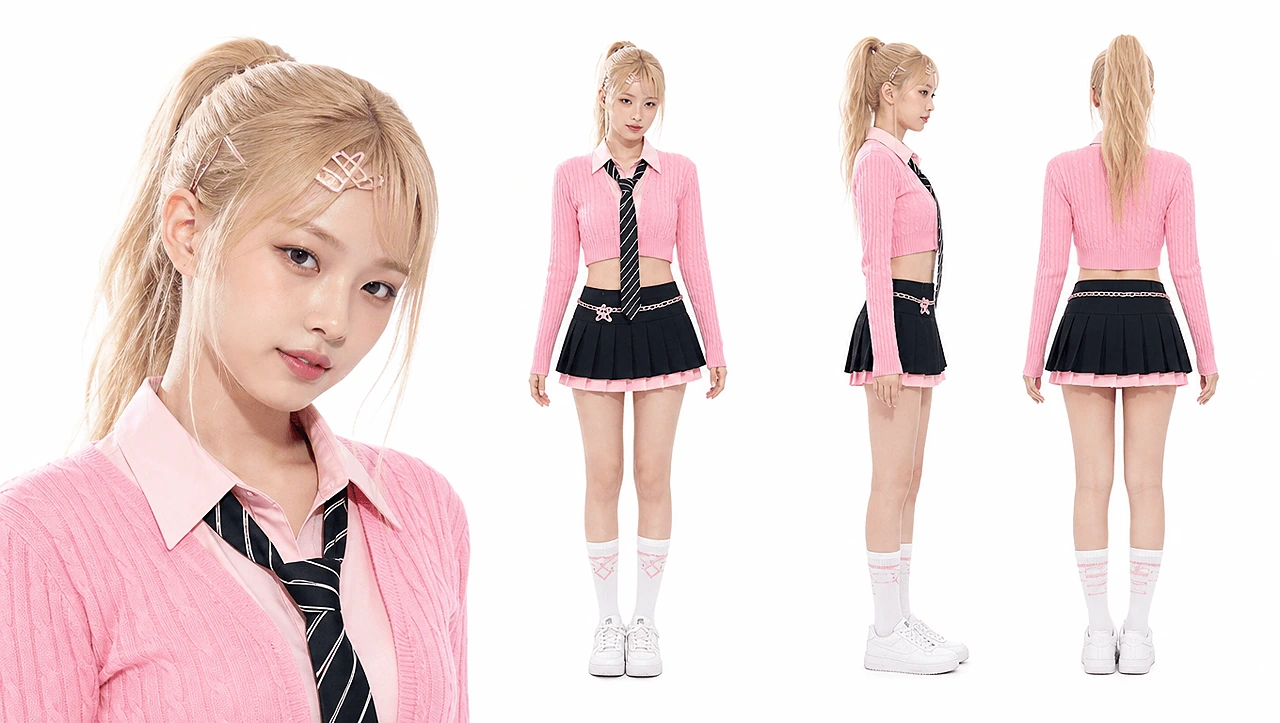
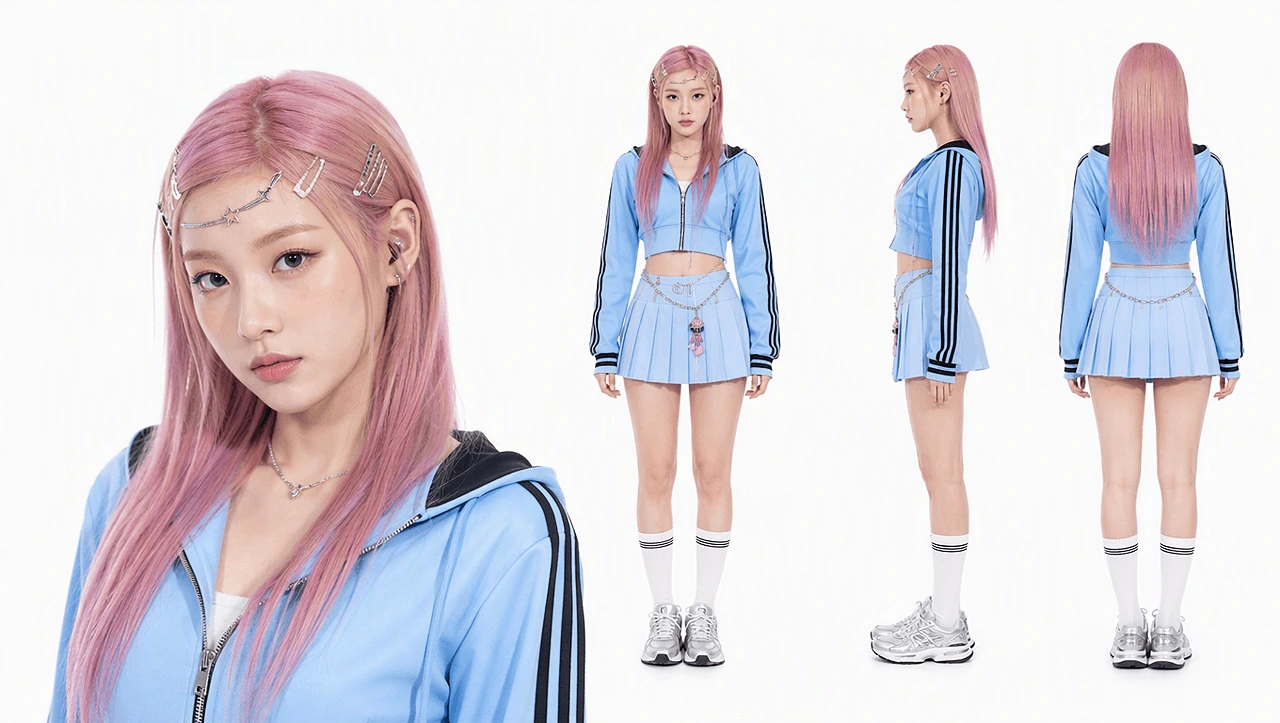
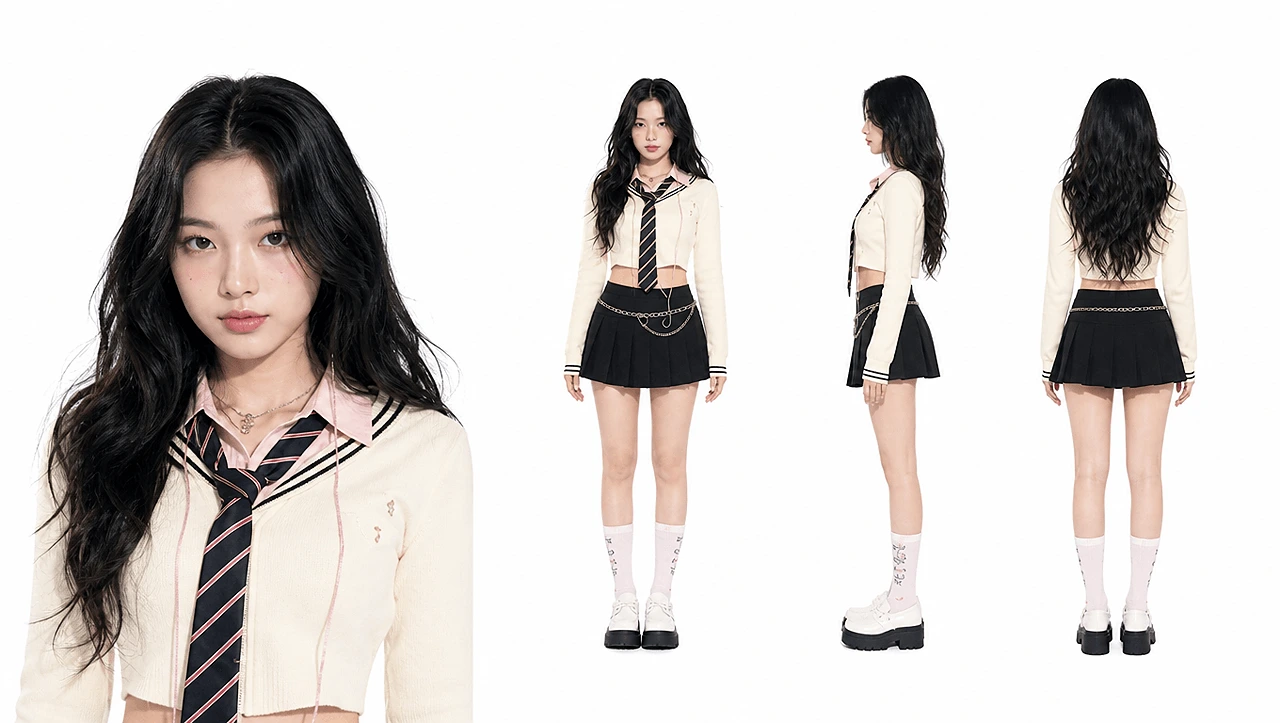
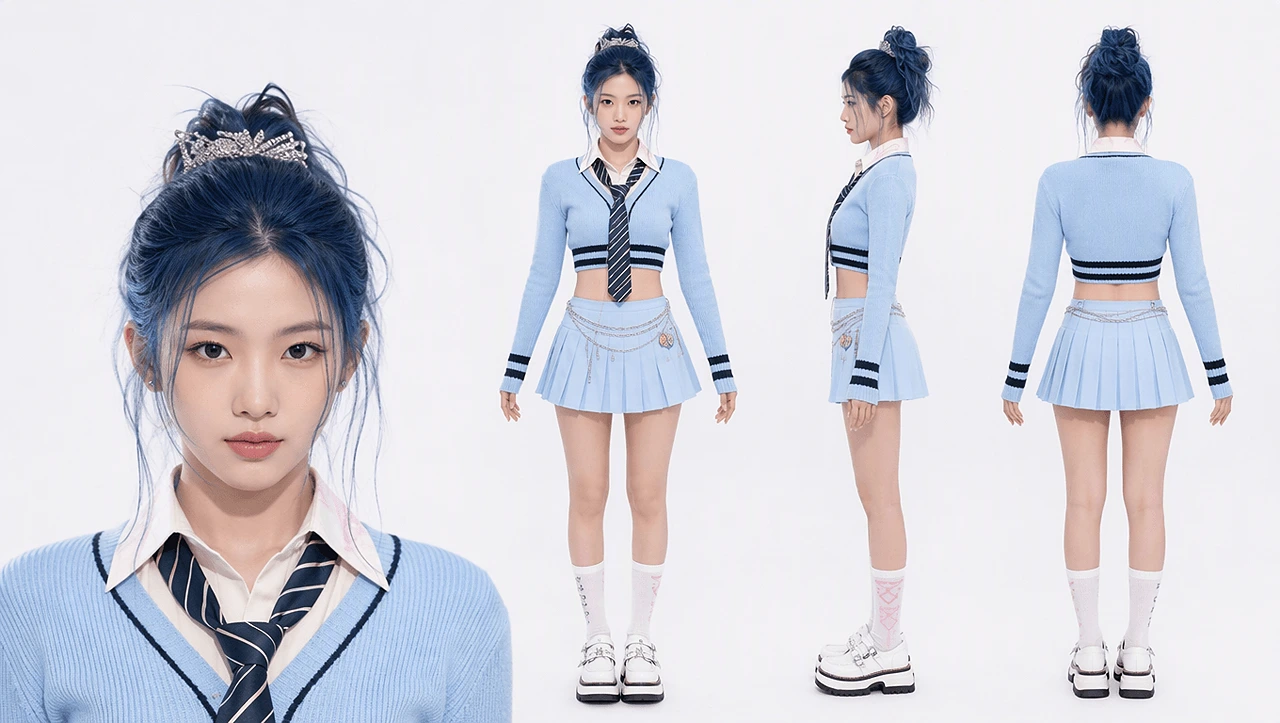
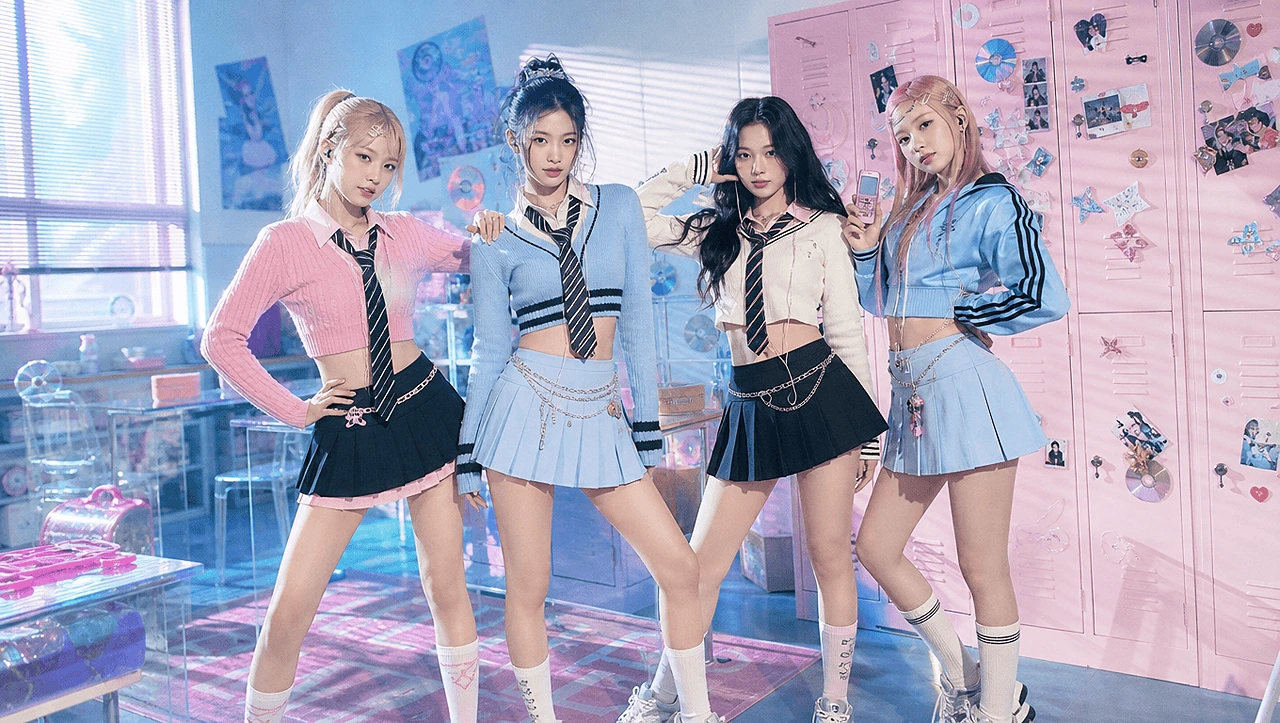
Create an original 30-second, 16:9 live-action Y2K sweet-and-edgy K-pop girl-group music video, with four adult female performers. Use Audio 4 (<<<aud_4>>>) as the single authoritative reference for the song, lyrics, vocal delivery, beats, and edit timing. Preserve the four alternating solo verses, four short group-response moments, and the final full-group chorus. Solo lyrics must be accurately lip-synced; group-response shots can feature playful interactions without forcing every member to mouth each word. Keep the track, bass, drums, and stage lighting at full intensity until 28 seconds. Only begin a smooth musical and visual fade during 28‒30s. The final five seconds must feature four distinct changing compositions― not a static five-second push-in. CHARACTER REFERENCES ― KEEP ALL FOUR IDENTITIES DISTINCT: Member 1 (Image 25): Light blonde high ponytail, pink collegiate Y2K outfit; preserve her face, proportions, hairstyle, outfit, and accessories. Member 2 (Image 20): Blue updo, powder-blue collegiate look; preserve the separate face and costume identity. Member 3 (Image 15): Long dark loose hair, cream collegiate outfit; preserve the separate face and costume identity. Member 4 (Image 24): Long pink-lavender hair, light-blue sporty collegiate outfit; preserve her face, silhouette, and accessories. Image 2: Group relationship, pastel pink/blue/cream styling, overall Y2K sweet-cool visual direction. Never blend faces, swap outfits, clone members, or introduce additional performers. 0‒3s | MEMBER 1 SOLO ― PINK CLASSROOM FANTASY SET. Cut directly to the blonde singer leaning against a transparent desk. Soft gradient pink wall, venetian-blind shadows, cream storage modules, floating abstract panels. She looks sideways, turns to camera, and lip-syncs: “Bell rings, cherry gloss, I’m out the door.” Playful eyes, natural turn and small hand gesture; no full choreography. 3‒5s | GROUP RESPONSE ― DESK PLAY. On “Hey! We’re ready for more,” Member 1 swipes a translucent card across the lens to transition. Four members gather around a clear acrylic table, swap bright notes, playfully bump shoulders, gesture to camera, and laugh. Keep the original vocals; line-by-line lip-sync is unnecessary in this cutaway. 5‒8s | MEMBER 2 SOLO ― ICE-BLUE AND CREAM MODULAR SET. A reflection along a mirror bench wipes to Member 2. The scene is predominantly cream with touches of low-saturation ice blue, fine silver framing, clear acrylic foreground, lilac frosted-glass screen, blush detail, and distinct foreground/midground/background layers. Never flood the frame with flat blue light. Member 2 steps forward with restrained cool confidence and accurately lip-syncs: “Flip-phone flash, I’m stealing the light.” Subtle push-in; focus remains on her eyes. 8‒10s | GROUP RESPONSE ― TRANSPARENT ROLLING CHAIR. She pushes a reflective panel across the lens, revealing the pastel lounge. Member 1 sits on a transparent rolling chair, Member 4 gently pushes it, and Members 2 and 3 jog beside them laughing. During “Oh! We own the night,” use a lateral tracking shot and spontaneous friend-group interaction; no required individual lip-sync. 10‒13s | MEMBER 3 SOLO ― CREAM MEDIA-CLASSROOM FANTASY. The rolling chair wipes into a soft cream set with modular shelving, translucent divider, faint pink blind-shaped light, thin acrylic console and tiny ice-blue indicators. Member 3 taps the console, glowing strips illuminate, and she raises her eyes toward the moving camera while lip-syncing: “Pastel dreams in the window shine.” Gentle breathing, turning and eye contact rather than dancing. 13‒15s | GROUP RESPONSE ― DIGITAL CAMERA FLASH. The console light blooms into a digital-camera flash transition. Four performers crowd together in a clean pink-and-cream photo corner, straighten each other's hair clips, lean shoulders together, and change funny expressions on the second flash. Retain “Yeah! This moment is mine” on the soundtrack without mandatory detailed lip-sync. 15‒18s | MEMBER 4 SOLO ― LAVENDER COMMUNICATION ROOM. The flash clears onto an original lilac modular studio with silver slim framing, frosted acrylic, cream low cabinets, soft horizontal lighting, and a transparent flip-phone prop. Member 4 lowers the receiver and approaches camera half a step, confidently lip-syncing: “Turn up the hall, let the whole school know.” Natural hair movement, open gesture, no complex dance. 18‒20s | GROUP RESPONSE ― ENTERING THE MAIN ARENA. During “One, two, three―let’s go!” Member 4 slides open a translucent divider. The other three peek out, link hands, and run forward into a glowing doorway. Their movement carries seamlessly into the final arena. 20‒23s | FINAL CHORUS ― UPGRADED STAGE. Reveal an original “After School Club Arena”: translucent curved rear wall, abstract locker-shaped arches at either side, floating silver elliptical structure, cream-and-light-wood reflective sports floor, pink-and-blue illuminated floor tracks, transparent raised platforms. All four perform synchronized full-body choreography and sing: “After school electric, e-e-electric.” The camera glides forward through the glowing doorway. 23‒25s | CHORUS PROGRESSION ― DIAMOND FORMATION. The members move from a horizontal line into a diamond, singing “Candy-coated confidence, magnetic.” Platform light strips respond like sound waves. The camera tracks from knee-height framing out to all four performers. Keep drums, bass, and vocals vivid. 25‒27s | CLIMAX A ― SIDEWAYS ARCUATE TRACK. On “Four hearts, one beat, lighting up the room,” the camera sweeps from stage front-left to front-right with foreground parallax from transparent platforms. The dancers interlace arm gestures, cross positions in two steps, half-turn, and open into a wide diagonal formation. Alternate full-body and knees-up framing, preserving all four identities. Music and lighting remain at their highest energy. 27‒28s | CLIMAX B ― LOW-ANGLE IMPACT. Hard cut to a slightly low-angle group shot, push in briefly then arc around the outer side. They clearly sing “Hands up together―watch us go boom!” together and land a precisely synchronized arm-raise, turn, and step on the final musical impact. The silver frame flashes from ice blue to bubblegum pink and floor strips ignite in sequence. No early musical fade before 28s. 28‒29s | FADE A ― PAIRED MEDIUM CLOSE-UPS. The lyrics have ended; retain wordless group harmony, synthesizer sustain, final drum tail, bass resonance, and reverberation while the volume steadily begins its two-second fade. Show a glance-to-camera from Members 1 and 2, wipe via hair and shoulder motion, then show Members 3 and 4 trading subtle expressions, each with a brief semi-orbit. Background lights dim in layers but faces stay legible. 29‒30s | FADE B ― FOUR-MEMBER FINAL HERO FRAME. Cut to a wide slightly low-angle group composition with an asymmetric staggered arrangement, two women at the front of the transparent platforms and two on a higher level. Keep only natural breathing, settling hair, and slight eye movement. The camera floats sideways and slowly pulls back, settling during the final half-second. Architecture, silver ring, reflective floor and pink-blue tracks fade softly with the last instrumental decay. No abrupt freeze, harsh cut, or unfinished ending. TRANSITIONS, STYLE AND QUALITY: Link scenes through practical on-camera swipes: translucent card, mirror wipe, rolling chair occlusion, camera flashes, sliding acrylic divider, and illuminated doorway. All solo studios share cream modular architecture, blind-shaped soft shadows, pale acrylic and subtle chrome, but each retains unique accents. Premium live-action music-video studio production, early-2000s fashion-magazine energy, bubblegum pink, ice blue, cream white, muted lilac, selective silver and black. Campus elements must be abstract and editorial rather than a realistic school. Real human skin, accurate facial identity and lip-sync, energetic but readable cinematography. No microphones, in-ear monitors, subtitles, on-screen text, extra people, or brand logos. PROTOTYPE ASSET NOTE: The referenced Audio 4 and Images 2, 15, 20, 24, 25 are source-material IDs from the production brief; they are not bundled in this preview HTML.
Specifiche del clip caricato: 30s · 16:9 · 720p · 24fps
Due persone compaiono su uno sfondo da studio giallo acceso, con batteria, amplificatori, gesti energici e cambi di posizione della camera. La sequenza alterna il corpo intero, le percussioni e l’interazione.
Topview T1
Seedance 2.5
Un’esibizione musicale mostra i punti deboli delle mani, del rapporto con gli oggetti, dell’aggancio al tempo e del rapporto tra le due persone.
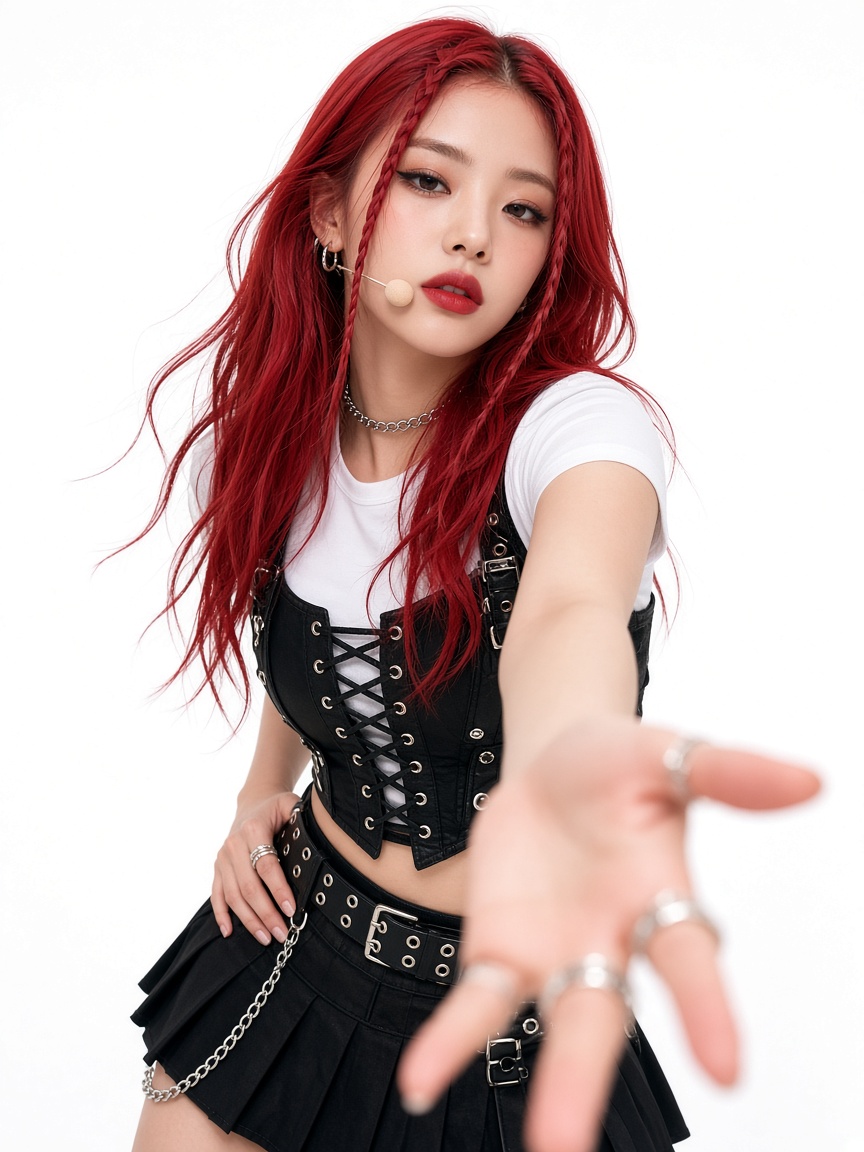
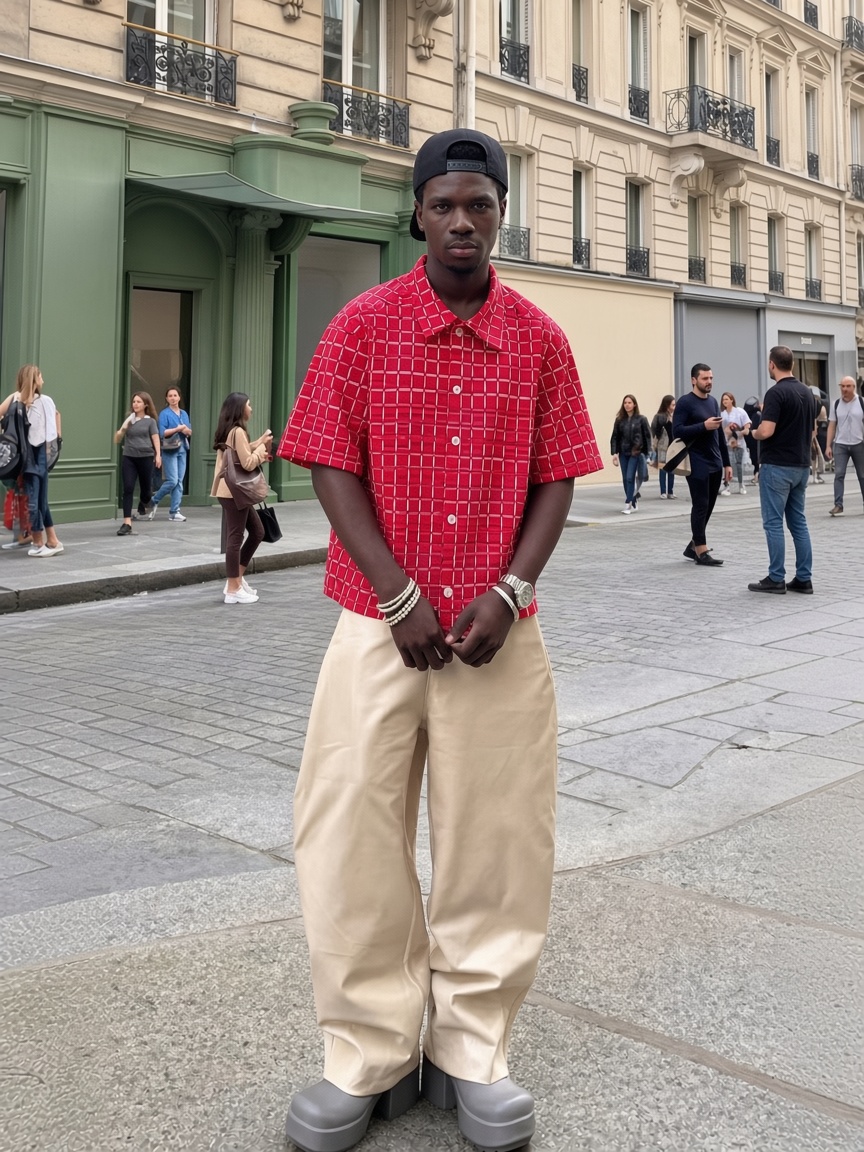
Solo Topview T1 segue per intero le azioni del video di riferimento. Entrambi i clip usano lo studio giallo e il guardaroba resta stabile in tutti e due: capelli rossi, corsetto nero, camicia a quadri, cappellino al contrario e pantaloni crema. Seedance 2.5 è un po’ più chiaro sulla danza a braccia alzate e sulla giacca nera mentre è in aria, ma non tiene l’azione di riferimento mossa per mossa come fa T1. Scegli Topview T1 quando l’esibizione deve coincidere con il video di riferimento mossa per mossa.
Video di riferimento
【TASK: Frame-by-frame remake of the reference video ― replace only the specified characters and studio color】 Use <<<Video1>>> as the sole reference for action, performance, character interaction, camera move, framing, edit rhythm, and timeline order. Fully replace the original male with the man in <<<Image2>>>, and the original female with the woman in <<<Image1>>>. Change the pink studio walls and floor to a bright, saturated, clean yellow. This is reference-video-driven character and set replacement ― not a new story, not a redesigned dance, not freestyle to the song. Final length ~26.67s, 16:9, 1920×1080, 30fps. Keep real action speed from the source ― no slow-mo, no stretch, no compress to 15s. Timecodes below are alignment aids; cuts, action starts/ends, and paths follow <<<Video1>>>. Only <<<Image2>>> male lead and <<<Image1>>> female lead ― no third person, dancers, crowd, or clones. 【1. Source roles & priority】 Video1: camera, staging, body action, expression timing, mouth, interaction, props, cuts, aspect inserts, light 2D doodle FX only. Do not inherit original actors’ faces, hair, beards, hats, or clothes. <<<Image2>>> locks: male face, skin, short curls, backward black baseball cap, build, red-white check shirt, cream wide trousers, chunky shoes, right-arm tattoo, wrist accessories. <<<Image1>>> locks: female face, long cherry-red hair with face-framing micro-braids, build, white baby tee under black lace-up corset vest, black pleated mini skirt, silver chain choker, flesh-tone headset mic. On conflict: looks/wardrobe from Image1/Image2; action/camera from Video1. Only micro-adapt kneel/sit/jacket-toss for the new clothes ― do not rewrite whole beats. 【2. Male consistency <<<Image2>>>】 Same adult man: dark skin, lean athletic, short dense black curls (tapered sides), clean jaw, faint upper-lip shadow only. Always wears a plain black baseball cap backwards (visor at the back). No glasses. Not the original actor’s face. Wardrobe always: oversized red-and-white windowpane short-sleeve shirt, extremely baggy cream/beige wide-leg trousers, grey/off-white chunky platform shoes. Multi-strand white beaded bracelets on right wrist; silver metal watch on left. Large black tattoo on right forearm wrist-to-below-elbow, inner and outer. Fixed to that same right arm ― never swap sides, never mirror both arms, never copy to upper arm/hand/clothes. Perform drums, nods, leans, dance, claps, floor games, cup sips, side-lie, and lip-sync as in Video1. Expressions change with performance. Plain black sunglasses and star party glasses are temporary props; after removal, no extra sunglasses remain on his face. No prop pop-in/out mid continuous shot. 【3. Female consistency <<<Image1>>>】 Same adult woman: East Asian, pale skin, slim, long cherry/crimson-red hair slightly wind-moved with two thin face-framing braids, sharp winged liner, blurred red lips, cool girl-crush look. Any facial mole stays fixed ― no mirror flip, no vanish in close-ups. Wardrobe always: white short-sleeve baby tee under black lace-up corset vest with silver grommets/buckles, black pleated mini skirt with grommet belt and side silver chain, silver chain choker, small hoops, multiple silver rings; flesh-tone headset mic near mouth. Never gold hair, green cami, burgundy floral skirt, brown boots, or other original looks. Keep playful energy: sing to camera, reach, head toss, shoulder lean, remove glasses, dance, clap, point laughing, cup sip, prop toss. Hair must be her own long red hair with natural inertia. Mic stays on face; on kneel/sit the mini skirt covers naturally ― not a long dress or pants. 【4. Set】 Keep open studio: seamless wall meets floor; speakers/gear left-right; drum kit scale/placement in drum beats; later dance/floor beats use matching gear layout (don’t force kit into dance zone). Replace all pink walls/floor with bright saturated clean yellow (real softbox falloff ― not neon, not orange-pink residue). Solid studio floor with contact shadows. Speakers black/dark grey; metal stands real. Recolor environment only ― no full-frame yellow grade on skin/clothes. Kick drum face clean black, no art/text. No logos, charts, coins, finance UI. 【5. Camera & edit】 Match playful retro music-video studio feel. Keep mid frontals, high angles, slight Dutch, close wide, mouth ECU, two-shots, fast cuts, short punches. No new slow-mo, long orbits, drone, audience, or redesigned oners. Real faces/fabric; light grain and motion blur. Keep letterboxed inserts and slight tilt. Output canvas 16:9. Strip platform watermarks/UI; no new titles/end cards. 【6. Shot timeline】 (cuts/action from Video1) Shot 01|00.00‒01.10|She sings foreground, he drums background Lowish frontal medium-wide. She kneels left FG with wired mic, lip-sync; red hair, white tee + black corset vest, black mini clear. He at kit rear-right: backward black cap, red-white check, cream trousers, drumming on beat; right-arm tattoo when visible. Clean black kick face. Shot 02|01.10‒04.30|High angle, she reaches to camera Free hand reaches into lens (strong FG perspective), then retract, point, head sway, lean; red hair moves. Camera rises/pulls to show more yellow floor and kit. He keeps drumming BG. Optional tiny lightning/star doodles at source hits. Shot 03|04.30‒07.67|Letterboxed shoulder interaction Black bars, slight tilt. He left at drums with sticks; she right leans on his shoulder ― arm wrap, side bend, head whip (red hair swings) per source. He stays seated nodding/tapping. Shot 04|07.67‒10.80|She takes his sunglasses, wears them Same physical black sunglasses: she lifts off his face, stands, turns, light hair toss, puts them on herself, re-leans. He has no thin eyeglasses; after transfer he must not still wear an identical pair. Backward cap stays on. Shot 05|10.80‒12.30|Letterboxed high two-shot She in the taken sunglasses leans on him lip-syncing; he keeps stick rhythm, brief eyes-closed/smile/tilt. Faces stay Image2 / Image1 distinct. Shot 06|12.30‒13.93|Her mouth ECU Her own lips/teeth/skin from Image1; mouth follows source syllables. Soft warm-gold instead of pink wash ― don’t yellow-tint lips/teeth. Shot 07|13.93‒15.57|Full-body synced dance He left, she right, full body: backward cap + check shirt + cream trousers + platforms; red hair + white tee/black vest + black pleated mini. Beat-for-beat elbows, shoulder pops, leans, weight shifts ― no mirror swap, no random waving. Shot 08|15.57‒16.37|Her close, him BG She FG head tilts/nods lip-sync; red hair + vest clear. He keeps dancing BG. Shot 09|16.37‒16.97|His close, her BG He FG lean, lip-sync, short chest gestures; backward cap, curls, check shirt locked. Tattoo only when angle shows it. Shot 10|16.97‒17.37|Side clap transition Side-turn steps + chest claps on downbeats; optional tiny line/lightning doodles. Shot 11|17.37‒20.47|Face-to-face floor clap game He left facing right, she right facing left; center small cup. Full clap → reach → contact → retract → clasp cycles; no sticky fingers, pass-through, or extra arms. Skirt and trousers sit naturally. Shot 12|20.47‒22.10|Giant star glasses sing to camera She left, he right, oversized five-point star party glasses; nod/tilt/lean lip-sync. Lower faces + hair/cap still readable. Shot 13|22.10‒23.40|Floor game, she points laughing She points at him, leans back laughing; he reacts head-down, hand up, cup, lean-back ― cause/effect intact. Shot 14|23.40‒23.80|Punch-in: she sips cup Fast push + blur; cup/lips contact real; red hair swings back. Don’t stretch to slow-mo. Shot 15|23.80‒24.30|He sips cup CU Same sip/lean rhythm; always Image2 face + backward cap + check shirt. Shot 16|24.30‒25.80|He FG side-lie; she BG swings/throws jacket He lower-left side-lying in check shirt, cream trousers, platforms, backward cap. She mid-rear swings one separate black jacket prop (not clothing she is wearing); she stays in white tee + black corset vest + black mini. Jacket path: side swing → toss up → flip → skim FG/exit per source. Never remove the skirt or switch to white top/black shorts. Shot 17|25.80‒26.67|Two-shot look/laugh end He left, she right, look at each other; side head, laugh up, brief look down, light sway. Keep Image2 / Image1 looks. No freeze portrait, hug, kiss, titles, or end card. End on source final frame. 【7. Sound & lips】Keep original track, tempo, vocal order, length. Lips follow syllables; drum hits and claps sync to contact. Don’t drown music with SFX. Same timeline ― don’t retimed the song. 【8. Hard avoids】No new plot/dance; no meeting/award/stage-crowd rewrite; no face-swap that keeps blonde/cap/leather of originals; no matching yellow outfits; no changing check shirt/cream pants or red-hair corset/black mini; no identity drift / tattoo side-swap; no prop teleport / sunglasses clone; no pink residue / full yellow grade; no subtitles, finance UI, watermarks; no slow-mo or stretched shots. Final goal: same shots, same actions, same interactions, same edit ― only the cast fully replaced by <<<Image2>>> male (with backward black cap) and <<<Image1>>> female (cherry-red hair + black corset look), and pink studio → clean yellow studio.
Specifiche del clip caricato: 30s · 16:9 · 720p · 24fps
Guerrieri in armatura affrontano creature fantastiche enormi su un campo di neve. La scena unisce una formazione, il freddo, effetti magici e azione su larga scala.
Topview T1
Seedance 2.5
Una scena fantasy può sembrare spettacolare e allo stesso tempo confusa nello spazio. Questo confronto guarda se l’azione si legge, se la scala regge e se c’è una causalità.
Topview T1 rende la scala più facile da leggere. Apre nella tenda cremisi, con gli stendardi del sole e il capitano, poi un gigante sopra un muro di scudi, una scansione viola sui giganti legati, una carica nella neve, orsi polari che restano enormi accanto ai soldati e un ultimo fotogramma in cui la testa di un orso riempie l’inquadratura accanto al viso del capitano. Seedance 2.5 apre nella foresta, non nella tenda. Il suo gigante sta più piccolo nel quadro, la carica nella neve tiene ancora un gigante dietro chi corre e il momento degli orsi include ancora un gigante di pietra. Il primo piano finale del capitano è il volto più nitido, con gli orsi dietro di lui. Scegli Topview T1 quando la taglia delle creature e il passaggio dalla tenda alla neve devono restare evidenti. Scegli Seedance 2.5 quando il volto finale del capitano deve essere il fotogramma più nitido.
A 30-second ultra-realistic 4K cinematic original war short, ultra-high saturation modern film look (crisp vivid film grain, not vintage). Fully original fantasy world ― invent all designs, no resemblance to any existing film, game, book, or myth franchise. No copyrighted characters, creatures, armor styles, or logos. EXACT ORDER: 0‒4s ― THE HOOK (50mm slow push → 85mm): A mixed medieval-fantasy army at a dark pine forest edge, holding deep crimson hand-painted cloth banners with simple geometric sun-disk emblems (original, non-trademark). A child in torn clothes flashes past crying for one second, then exits forever. A scarred captain in custom riveted iron plate and a worn crimson cloak whispers English only: “What is that?” Soldiers exchange uneasy looks. Oppressive quiet, shallow DOF, out-of-focus banner cloth in foreground bokeh. 4‒9s ― THE EMERGENCE (28mm low-angle wide): Thin mist parts. A line of original colossal humanoid war-constructs steps out ― rough basalt-skin bodies, rope-bound wooden plating, bone charms, unique silhouette unlike any known giant IP. They tower over the banners. Captain bellows: “RUN!” Rack focus from a spear tip in foreground to a massive stone foot. 9‒13s ― SCAN 1 / FOREST→SNOW: Soft freeze stutter. Very low-key pale purple local scan sweeps trees only ― thin, restrained, not flashy. Forest hard-replaces to open snowfield; same army and constructs, continuity held. 13‒22s ― RUNNING WAR (35mm steadicam + 85mm ECU): Soldiers flee while fighting. Constructs smash fleeing lines; spears snap, men hurled into snow, crimson banners drag and fall. Captain briefly counters then keeps running. Tracking beside panicked soldiers, OTS strikes, ultra-close practical impact inserts (boot, shield, snow burst), whip pans, half-beat pauses. No magic energy beams. 22‒26s ― SCAN 2 / CONSTRUCTS→WHITE BEARS: Soft freeze. Pale purple local scan only across construct bodies; they hard-replace into same-scale giant wild polar bears (natural animals, no armored fantasy brands). Action unbroken: bears roar and smash, soldiers keep fleeing and fighting. 26‒30s ― AFTERSHOCK (28mm wide → 85mm punch-in): Chaotic snow war ― polar bears advancing, banners collapsing, soldiers scattering. No child. End on captain’s exhausted determined face racked into sharp focus, a bear silhouette soft behind him. No logos, no text, no watermark. CAMERA LOCK (key nodes only): 28mm low-angle scale, 35mm chase tracking, 50‒85mm faces, rack focus, OTS, shallow foreground bokeh. Anamorphic cinema feel, fine film grain, ultra-high saturation crimson accents, breath fog. Purple scans subtle and local only. No neon, no ruins, no kinetic FX, no franchise lookalikes. English dialogue only.
Specifiche del clip caricato: 30s · 16:9 · 1080p · 30fps
Una giovane affronta nelle strade di una città una creatura gigante dagli occhi rossi, simile a un ragno. Ci sono luce sulle mani, zampe in movimento, veicoli, movimento dell’ambiente e forti cambi di distanza della camera.
Topview T1
Seedance 2.5
È la candidata più esigente per un confronto di effetti con le stesse dimensioni in pixel all’esportazione. Serve a vedere se lo spettacolo veloce resta comprensibile in una scena lunga.
Topview T1 racconta lo scontro a colpi separati. Entrambi i clip tengono una donna dai capelli blu in un vestito lime su una strada bagnata, con taxi gialli e un solo ragno grande. T1 passa dal camion al ragno sopra di esso, al pugno con luce sulle mani, un primo piano della zampa, l’impatto, un taxi ribaltato, occhi luminosi e un ritratto finale. Seedance 2.5 rende prima evidente la taglia del ragno rispetto alla strada, compresa la donna in piedi davanti al ragno e al taxi, ma il fascio luminoso si legge come se uscisse dal ragno, e il finale ripete primi piani simili di avvicinamento camminando. Scegli Topview T1 quando il pugno e le mani luminose devono leggersi da soli. Scegli Seedance 2.5 quando conta di più la scala della creatura nella strada.
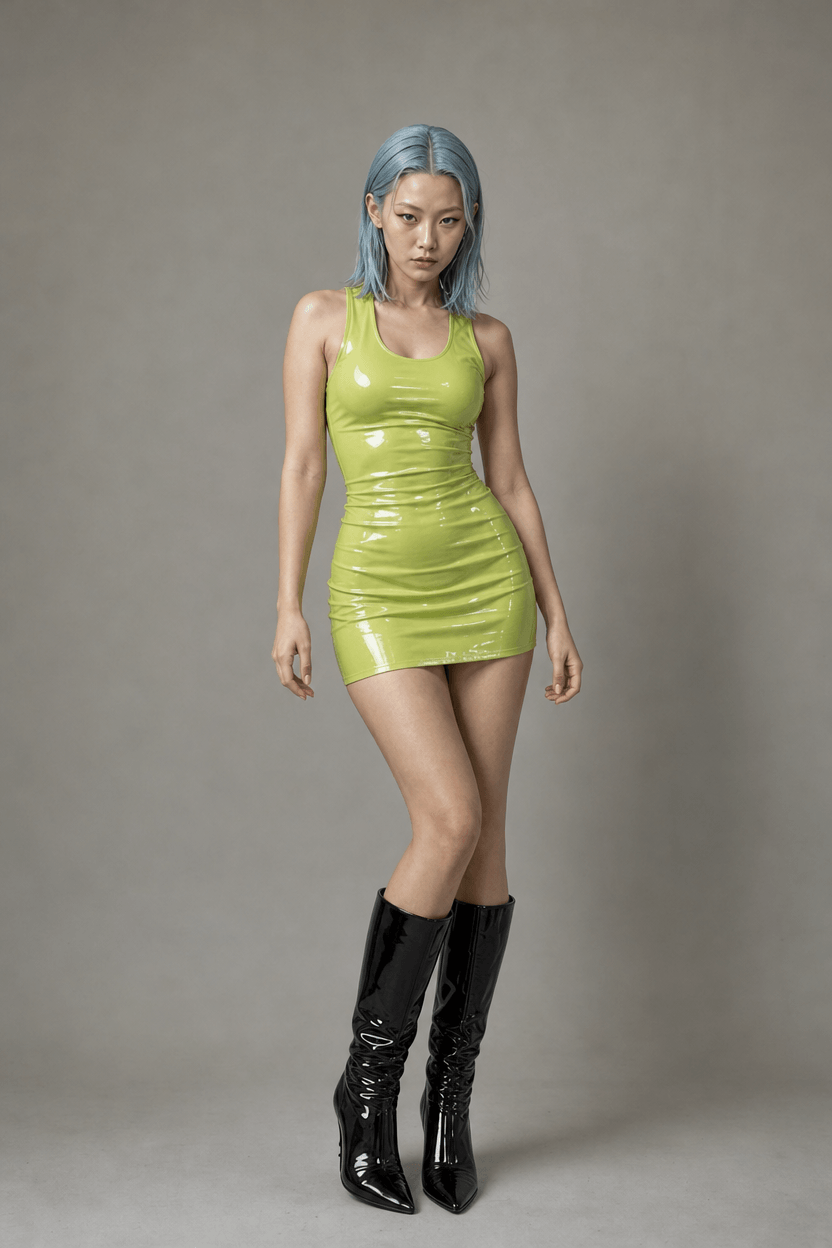
Create a 30-second, 16:9 photorealistic live-action action sequence on an overcast Manhattan street after rain. Wet asphalt reflects yellow taxis and gray buildings. [Subject] is the protagonist. Keep the protagonist’s identity and appearance consistent throughout, without specifying gender, facial features, hairstyle, or clothing. The monster is one giant reddish-brown spider with exactly eight clearly articulated legs and a cluster of glowing red eyes. Maintain a consistent street layout: the white box truck is up the street, an overturned yellow taxi is on the protagonist’s left, and a parked car is on the right. Keep the action on one side of the street axis so the direction of movement remains clear. 00:00‒00:03 ― Street and warning Wide establishing shot from a low, 24mm street-level camera tracking beside a shallow puddle. A yellow taxi crosses the foreground, briefly wiping the frame. As it clears, the white box truck comes into view up the street and jolts violently. Make a quick handheld push toward the truck. Original, wordless male humming begins quietly beneath traffic noise. 00:03‒00:07 ― Spider reveal Cut to a tight, low-angle shot of the truck’s rear doors buckling outward. The camera snaps back to a wider three-quarter view as the cargo box tears open and the spider emerges. Follow one leg striking the asphalt in a brief ground-level insert, then tilt up to reveal its full scale. It overturns a taxi; the camera operator instinctively stumbles backward as pedestrians run past the lens. Keep all eight legs visually distinct. 00:07‒00:11 ― Protagonist reveal Cut behind [Subject] in a medium over-the-shoulder shot, with the spider visible up the street. Arc the handheld camera around to a front medium close-up without crossing the action axis. [Subject] stops rather than running. Rack focus from the spider in the background to pink electrical arcs gathering around the protagonist’s fists. Finish with a quick close insert of electricity reflected in the wet road. 00:11‒00:15 ― First strike From a low side angle, track laterally with a spider leg as it thrusts toward [Subject]. Cut wider before the dodge so the complete movement is readable. [Subject] steps aside and punches the leg joint. Switch to a tight impact shot for a fraction of a second: the fist connects, pink electricity branches across the leg, and droplets jump from its surface. Use only a brief slow-motion accent at contact, then return to real speed. 00:15‒00:19 ― Leap and counterpunch Start with a wide shot that shows [Subject], the overturned taxi, and the spider in the same frame. A low tracking camera follows [Subject] running toward the taxi and using it to jump. Cut to a rising side angle that follows the jump’s arc; avoid an impossible midair camera orbit. [Subject] lands on the spider’s cephalothorax. A tight, slightly shaky overhead shot catches the downward punch, followed by a wider reaction shot as the spider recoils. 00:19‒00:23 ― Thrown into the car Hold a medium-wide shot long enough to show the spider’s physical movement throwing [Subject] toward the parked car on the right. Pan with the trajectory rather than cutting away. The car door dents on impact and its windows vibrate. Cut to a close, canted handheld shot beside the car: sound drops into muffled ringing, [Subject] grips the bodywork and rises, and pink light briefly appears in their eyes. Preserve the protagonist’s face and identity. 00:23‒00:27 ― Electrical blast Begin behind [Subject] in a low over-the-shoulder shot, framing both extended fists and the spider down the street. [Subject] releases one concentrated pink electrical blast. Cut to a wide frontal view of the spider so its resistance is visible: all eight legs dig into the wet asphalt before it slides backward several meters. Use a short close insert of sparks and water spraying from its feet. Return to the wide shot to show the full distance it has been pushed. Do not turn the blast into an explosion. 00:27‒00:30 ― Shock and silence As the electricity fades, follow [Subject] descending into the intersection with a gentle handheld tilt down. Move into a slow, restrained push-in from medium shot to close-up. [Subject] breathes hard and looks toward the distant spider, visibly shocked by what just happened. The music cuts out; only rain, electrical fizz, and a faint siren remain. [Subject] quietly says, “Stay there.” Hold for a beat with subtle handheld movement, then cut to black. Overall camera language: Immediate, physical handheld photography; grounded low angles that establish scale; clear wide shots before complex actions; close inserts only for decisive details. Use brief slow motion at the two major punches, never throughout the fight. Natural overcast light and cool gray streets contrast with vivid pink electricity. Give every jump, collision, and monster movement realistic weight. Maintain consistent protagonist identity, spider anatomy, vehicle positions, and screen direction across every cut. No on-screen text. Audio: Use original, wordless vocal textures and original ambient scoring only. Build the action with tire skids, metal impacts, footsteps, spider legs striking asphalt, rain, and electrical crackle. Do not use, quote, reference, or imitate any existing song, melody, recording, or artist. Negative prompt: cartoon, anime, plastic skin, blurry action, warped face, changing protagonist identity, extra human limbs, bad hands, spider with fewer or more than eight legs, fused or mushy legs, changing monster design, weightless impacts, rubbery vehicle damage, sunshine, impossible camera movement, confusing screen direction, gore, text, watermark.
Specifiche del clip caricato: 25s · 16:9 · 720p · 24fps
Un’investigatrice si avvicina a una scena del crimine transennata in una città giapponese, con un collega più anziano in completo. La scena attraversa strade residenziali, passanti, veicoli della polizia e il lavoro forense.
Topview T1
Seedance 2.5
Il dramma criminale realistico dipende da un’interpretazione misurata e da uno sfondo credibile. La sfida è sostenere quella realtà, non solo alzare gli effetti.
Topview T1 rende più facile seguire il percorso degli investigatori e la loro posizione nella scena. Entrambi i clip tengono la donna in blazer nero e l’uomo più anziano in completo, e arrivano al nastro giallo, a un’auto della polizia giapponese e a tute forensi blu. La scritta su entrambe le auto è una marcatura di polizia corretta. Sull’auto di T1 il carattere 庁 è ripetuto. T1 mostra comunque il percorso più chiaro: lei entra da un vicolo residenziale tranquillo, passa l’auto e arriva al segnalino con il nastro, dove gli investigatori sono in ginocchio, così la direzione della scena resta leggibile. Seedance 2.5 apre già dentro la folla. Scegli Topview T1 quando l’avvicinamento e la disposizione del luogo devono restare chiari.
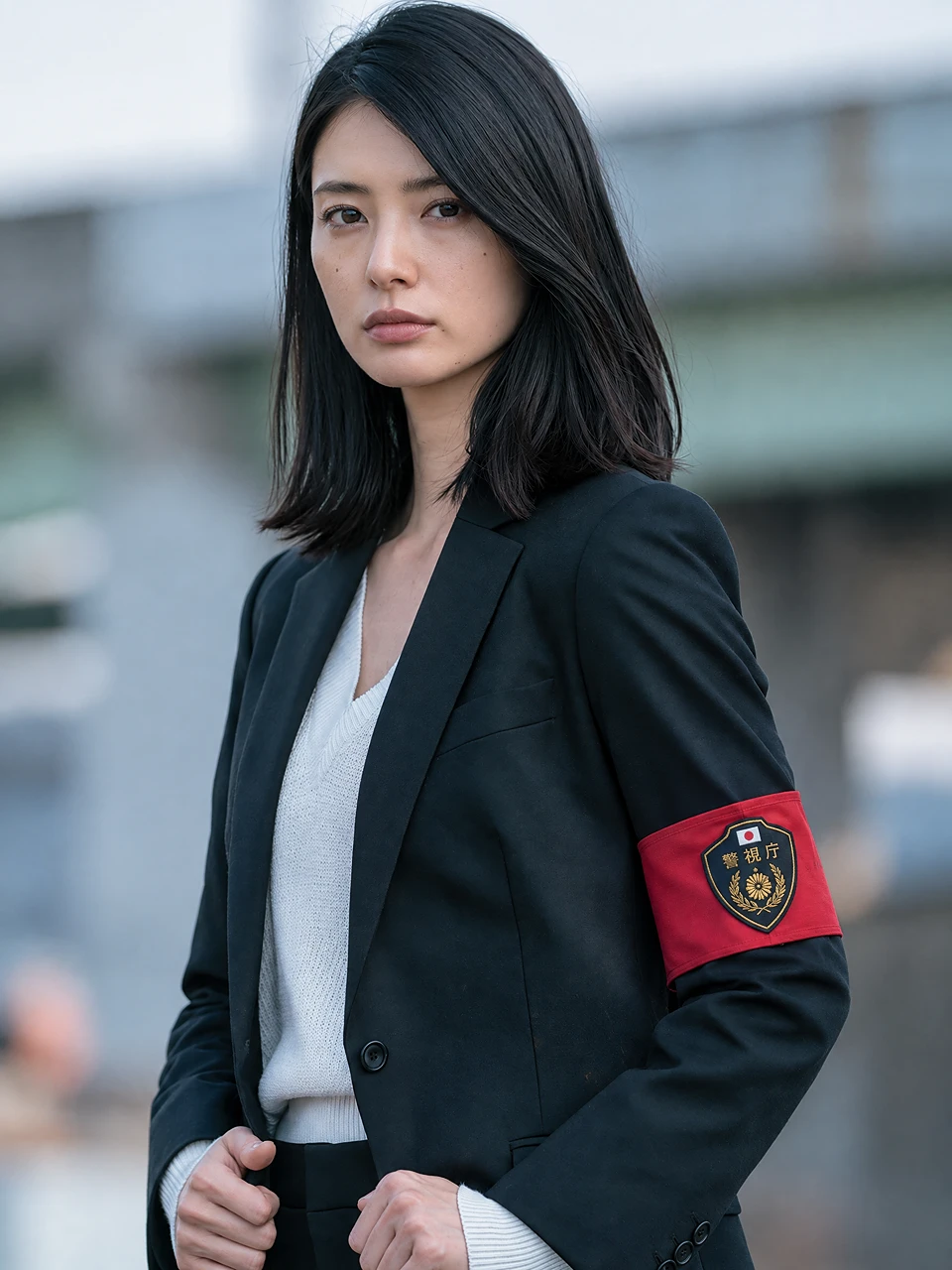
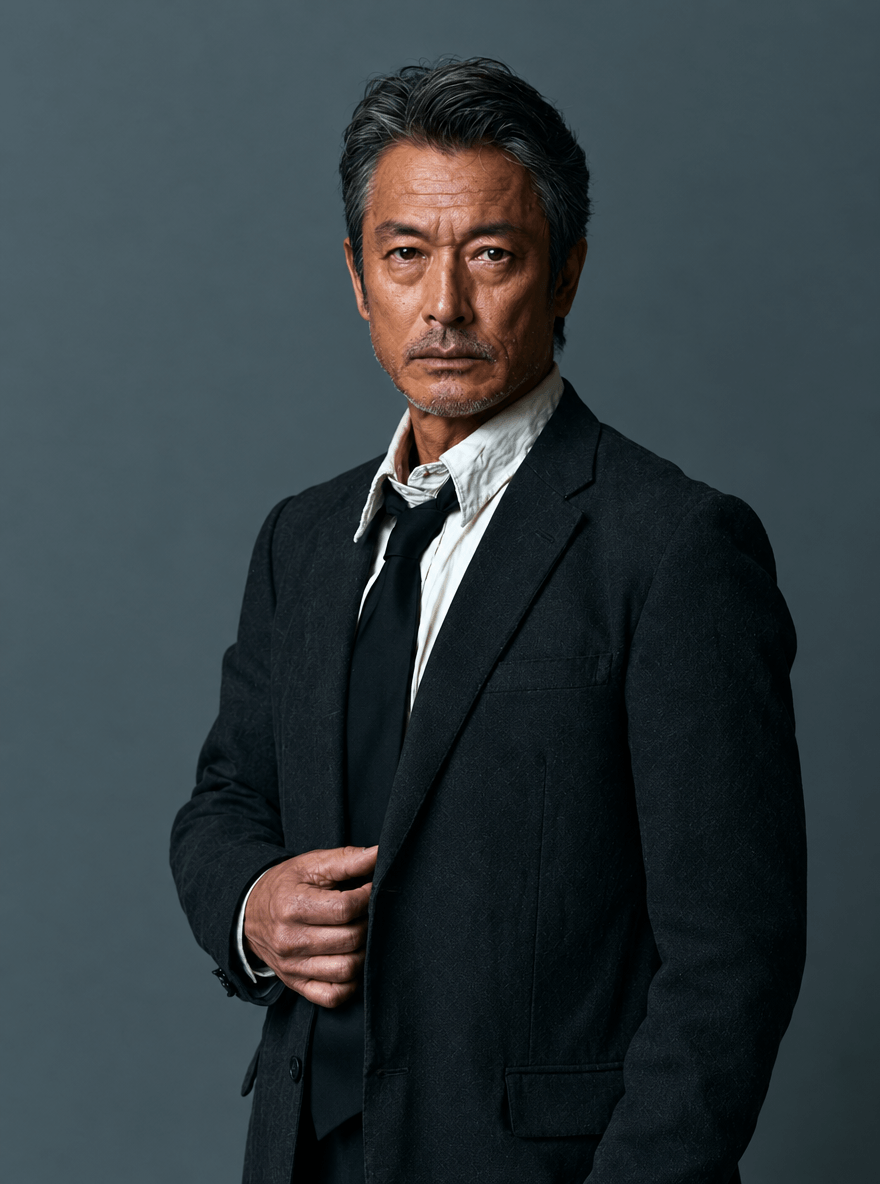
Create a 25-second photorealistic Japanese crime-drama sequence in a quiet residential district of Tokyo, filmed in ONE UNBROKEN TAKE: no cuts, invisible cuts, time skips, location changes, or editorial transitions. Format 16:9 landscape, 30 fps, with high-end 4K-capture aesthetics and an observational TV-drama/documentary crime-scene feel. Restrained, natural and professional acting―no fashion-commercial posing, heroic introductions, or exaggerated shock. LOCATION AND TONE: A typical Tokyo apartment neighborhood at about 4 p.m. on a fully overcast workday. Narrow asphalt road between mid-rise apartment buildings, white metal guardrails, modest palm-like greenery, an ordinary white police vehicle, several quiet onlookers, and a cordoned forensic zone farther ahead. The crime happened recently and police are still photographing evidence, organizing witnesses, and controlling access. Natural overcast daylight is the only key light. The mood advances from routine arrival to alert observation, partner reunion, entering the controlled scene, noticing evidence on the ground, and finally looking upward at an unexplained disturbance in the apartment building; never reveal the mystery itself. CHARACTERS AND REFERENCES: Character A (<<@img_8>>) is an adult Japanese female investigator with shoulder-length straight black hair, realistic skin, a dark tailored suit, white knit inner top, and a red police armband on her left upper arm. Character B (<<@img_6>>) is a middle-aged Japanese male investigator with slightly graying short black hair, tired under-eye skin, a weathered dark suit, wrinkled light shirt, and black tie. B wears NO armband. The police vehicle follows reference <<@img_7>>. Preserve each person's own facial identity, age, styling, body shape, costume and arm placement through pans, occlusions, motion blur and refocusing. Do not beautify B into a young fashion model or duplicate either lead among the extras. LENS AND EXPOSURE: Simulate a single full-frame equivalent 26mm prime lens throughout. Never zoom or change lenses. Shoot 30fps with approximately 1/60s shutter for natural motion blur. Work around T4 aperture, adjusting gently toward T3.2 only if the building shade requires it. Approximately ISO 800, fixed 5600K white balance, slightly restrained exposure protecting cloudy skies and white police car highlights, yet maintaining dark-suit texture. Camera altitude usually 1.4‒1.6m, lowered gradually to about 1.2m while passing the cordon. Move as a professionally operated human-height floating follow camera: progressive acceleration, inertia, gentle deceleration, mild handheld footfall movement, breathing and imperfect human reframing. No weightless or mechanically flawless motion. FOCUS AND LOOK: Authentic wireless follow-focus behavior shifts between A's eyes, B's face, the hand lifting the caution tape, and the evidence on the ground. Brief natural focus softness during occlusions and fast pans is acceptable, then reacquire without repeated purposeless hunting. Slight optical softness and motion blur, medium-to-deep readable depth of field. Retain visible pores, age lines, uneven real skin, natural specular oil, soft under-eye shadows, and B's subtle stubble. Restrained low-saturation cool gray, gray-green, blue-gray, charcoal and naturally pale skin; the only notable accents are the red armband, muted red cones, and yellow/black caution tape. No HDR, neon, orange/teal grading, beauty filters, artificial rim light or glowing ad-style treatment. BACKGROUND DIRECTION: Uniformed officers take separate unsynchronized actions―watch the perimeter, talk quietly, use radios. Forensic technicians independently kneel to photograph the site, position evidence markers, exchange bags and carry a case. Journalists and residents act differently; one reporter holds takeaway coffee, another checks notes, residents glance from behind the rail or lower phones. Some background people remain still. None stare at the camera, copy the leads' faces, or move in synchronized patterns. PERFORMANCE RULES: A and B naturally blink at unsynchronized intervals―roughly 3‒5 times for A and 2‒4 for B across 25 seconds, fewer during urgent attention. A's eyes lead head and shoulders; feet and weight lead directional change. Eye tension precedes changes in mouth and breath. B is about half a beat behind A's observations, eye lines and turns. A remains pragmatic and slightly tense, never performing for camera. 25-SECOND CONTINUOUS CAMERA BLOCKING: 0‒2s | Start close behind A at her right rear, about 0.5m away; her red armband enters first as she walks toward the apartments. Rise from roughly 1.3m to 1.5m and shift focus from armband to shoulder. White police car slides out on the right. 2‒4s | Follow A from one meter behind, letting upper apartment balconies and cloudy façade reveal above her shoulder while the distant caution tape becomes visible. Natural handheld micro-roll. 4‒6s | Arc smoothly around A's left side to her left-front, about one meter away. Her eyes scan the building then crowd; white railings slide across the background, onlookers move at different times, a brief shoulder occlusion leads to renewed focus on her eyes. 6‒8s | Walk backward ahead of A, leaving visual room for her gaze toward the cordon, crowd and building entrance. She slows, gathers herself, and becomes more vigilant. Reporters and distant officers continue independent activity. 8‒10s | A glances toward the right-rear, exits frame left as the camera accelerates into a motivated pan and lateral move to discover B next to the open police car door. Let the guardrail and onlookers create continuous motion blur; brake naturally and rack focus from door edge to B. 10‒12s | B lets go of the open car door, steps onto the road, straightens his worn jacket, examines the building and follows A. Camera retreats from approximately 1.5m ahead, gradually re-centering the scene to leave A room to return. 12‒14s | A walks back into frame from the left. B catches up at her right-rear by half a body length, and they approach the caution tape together. Both share a coherent frame. Technicians behind the tape photograph the ground and organize evidence bags. 14‒16s | A studies the tape height and reaches out with her RIGHT hand, back of hand first, then turning palm to lift the underside. B slows and raises his LEFT hand ready to take over. Lower camera from 1.5m to 1.4m, glance toward the hand/tape contact, then refocus on A. 16‒18s | A ducks under the tape with a physically correct right-foot-then-left-foot passage; B holds the tape with his LEFT hand and follows. The camera lowers to around 1.2m and retreats through the actual opening created by A. The yellow tape briefly blurs close to the lens. Maintain tape continuity and realistic recoil. 18‒20s | Beyond the cordon, A straightens and looks down at floor evidence; B releases the tape, which settles naturally. Camera gently arcs toward A's side/rear, tilts down and picks up evidence while A's shoulder forms a soft foreground. Technicians continue taking photos and shifting a case. 20‒22s | A's eyes rise before her chin and shoulders; she notices something above the building. B follows her attention slightly later. Camera orbits gradually to her front-right, lifts to 1.6m and racks from evidence back to A's eyes. Do not show the unseen target. 22‒24s | A stops 0.8m from lens, positioned frame right, gaze fixed upward-left; B remains roughly 1.5m behind frame left, later raising his head. Push in slightly while allowing small stabilizing motions. A's jaw firms, breath shallows. The apartment exterior occupies only the top edge of the frame. 24‒25s | Finish on A's watchful face as she holds the upward look, makes one slow natural blink, then stares. B remains perceptible behind, focused on the same unknown. Only slight handheld settling; no cut, no spoken line, no mystery reveal. SOUND: Absolutely no musical score or stylized suspense sting. Continuous grounded ambience from distant Tokyo traffic, dry leaves rustling, subtle Japanese murmurs from residents and reporters, camera shutter clicks, independently timed footsteps and clothing fabric, quiet breathing, paper rustle, takeaway-cup tapping, tape tension/recoil, forensic case sounds, and at most one or two unobtrusive distant phone notifications. Audio direction and distance must evolve smoothly with the moving camera. No sirens, police-car engine, melodramatic low-frequency hits, heartbeats, synthetic risers or dialogue from A or B. CONTINUITY / NEGATIVE CONSTRAINTS: No editing, hidden cuts, teleportation, axis reversals, changes in spatial geography, or sudden focal-length changes. A and B never swap identity, positions, faces, clothes, hairstyles, or the armband; keep A's RIGHT hand lifting the tape and B's LEFT hand taking over. Do not place the tape elsewhere, let it float, pass through bodies, snap, melt, or spontaneously move. No malformed hands, drifting feet, body intersections, duplicated faces, synchronized extras, artificial eye blinking, exposure or white-balance jumps, over-processed HDR, neon, unnecessary focus hunting, or character dialogue. This is intimate, imperfect, uninterrupted, observational Japanese crime television with a mounting sense of mystery. PROTOTYPE ASSET NOTE: The reference identifiers <<@img_8>>, <<@img_6>>, and <<@img_7>> come from the supplied production brief. The underlying reference files are not embedded in this HTML prototype.
Specifiche del clip caricato: 30s · 16:9 · 720p · 24fps
Una scena di Halloween giocosa si svolge in un corridoio in penombra, con zucche luminose. Compare un fantasma coperto da un lenzuolo mentre entrano bambini in costume e reagiscono, e la sorpresa comica cresce.
Topview T1
Seedance 2.5
La commedia e i corti da brivido chiedono reazioni a tempo, posizioni chiare e una messa in scena stabile. Questo confronto verifica se il modello chiude una storia semplice senza perdere quell’impianto visivo.
Topview T1 tiene immagine e storia in un ordine logico. Entrambi i clip usano un corridoio giapponese, porte shoji e file di zucche luminose. In T1 il fantasma col lenzuolo compare, e le persone reagiscono dopo averlo potuto vedere. Seedance 2.5 mostra qualcuno già spaventato prima che il fantasma compaia, così la causa della battuta arriva troppo tardi. Scegli Topview T1 quando la scena del corridoio deve restare coerente da un momento al successivo.
A photorealistic short set in a haunted house inside a traditional Japanese home during Halloween. Shot handheld by another staff member, with each shot about 2 seconds long. No dialogue, subtitles, or background music. Characters Sakura: a young woman playing the haunted house ghost. She is covered head to toe in a large white bedsheet with two round eye holes, the hem dragging on the floor. She stays under the sheet the whole time and never shows her head or face. The senior staffer: a man in his thirties in dark work clothes, holding a flashlight. Other guests appear only briefly in their own shots. Fixed rules There is only one ghost, Sakura. Her look never changes, and the sheet is never lifted. The closet is always on the left side of the frame, and the senior staffer hides behind a shoji door on the right. Guests always move in one direction, from the back of the frame toward the camera. The hallway is lined with jack-o'-lanterns, with warm orange light and dark surroundings. The sheet always hangs naturally and never floats. Shot order The jack-o'-lantern hallway. The closet on the left slides open and the bedsheet ghost jumps out, spreading her sheet up high with both hands. A couple glances at her; the guy even pulls out his phone for a selfie with her, and they walk past laughing. The ghost lowers her arms and retreats into the closet, disappointed. Inside the closet, the bedsheet ghost stomps in frustration, her fists clenched under the sheet. Two housewives walk past, chatting. The ghost rushes out, but steps on her hem and stumbles. By the time she steadies herself, they're already far away, and she can only raise her sheet at their backs. The senior staffer comes over, pats her on the shoulder, points to the shoji door on the right, and flashes a flashlight twice to show her the cue. Inside the closet, the ghost's shoulders rise and fall with a deep breath. She hitches up her hem and gives a determined nod. Through the gap in the closet door, two little boys wearing devil horns and capes timidly approach, holding hands. Behind the shoji door on the right, the flashlight flashes once, then twice. The ghost bursts out of the closet and spreads her sheet up high. The two boys scream, jump, and cling to each other. The boys turn and run away, and one of them drops his devil horns on the floor. Left behind, the ghost is startled by their screams and falls back onto the floor. The sheet stays over her head, and she trembles all over. The curtain on the shoji door lifts again. Several staff members peek out with wide eyes, then silently applaud her. The ghost picks up the devil horns and shyly puts them on top of her sheet. She takes the senior staffer's hand to get up, gives a happy little wiggle, and returns to the closet.
Guardiamo se ogni risultato serve il compito creativo di partenza, non quale fotogramma sembra più drammatico.
Per un test controllato abbiamo usato lo stesso prompt originale, gli stessi file di partenza, la durata prevista, le proporzioni, la risoluzione e l’impostazione audio ovunque entrambi i modelli li supportino.
Per ogni output abbiamo annotato la durata reale, le dimensioni in pixel, la frequenza dei fotogrammi, la traccia audio, l’identificativo di invio e il modello scelto. Quelle proprietà tecniche non sostituiscono un giudizio sulla qualità del modello.
Abbiamo usato una griglia fissata prima per l’aderenza al prompt, la coerenza dei personaggi, il movimento e la continuità di scena, l’allineamento audiovisivo e l’utilità pratica. Ciò che non si applicava è stato segnato come non applicabile.
Nel registro sono rimasti i compiti falliti, gli output rifiutati, i nuovi tentativi e i video riusciti. Un compito che si chiude sul piano tecnico non equivale a un video utilizzabile.
Il campione rappresentativo mostrato in questa pagina usa un numero di campioni dichiarato in anticipo e un punteggio in cieco.
Il tempo mediano di completamento si misura dall’invio al risultato scaricabile per i compiti conclusi. Il tasso di completamento usa tutti i tentativi inviati. Il costo per video utilizzabile include i crediti dei tentativi non accettati. Tasso di completamento = generazioni completate ÷ tutti i compiti inviati. Tasso di video utilizzabile = output accettati ÷ tutti i compiti inviati. Costo per video utilizzabile = tutti i crediti addebitati ÷ output accettati.
Un video forte o debole non dimostra che un modello si comporti sempre così. Le differenze possono venire dal prompt, dai riferimenti, dalla variazione casuale, dalle impostazioni o dal montaggio.
Topview pubblica ora una tariffa T1 in 1080p di 2.2 crediti al secondo per ogni membro, pari a $0.22/s.
Le tariffe di Seedance 2.5 cambiano secondo abbonamento, flusso e sconti; il preventivo in tempo reale può mostrare una differenza più piccola o diversa.
Un progetto può avere più inquadrature e più tentativi per inquadratura. Usa la tariffa che vedi nel tuo account per stimare il lavoro.
Crediti stimati = numero di inquadrature × generazioni per inquadratura × secondi per generazione × crediti al secondo.
Esempio di budget T1:
Totale stimato: 660 crediti per 300 secondi generati.
Quel totale è il metraggio generato, non la durata del montaggio finito. Il costo reale può cambiare se usi un altro flusso, una promozione o un vantaggio dell’abbonamento.
Vedi i prezzi di TopviewIn una scena di dialogo o in un corto drammatico possono servire più interpretazioni prima che il montaggio funzioni. La tariffa membri 1080p pubblicata di T1 rende più semplice stimare il costo di quei tentativi.
Se ti servono solo fino a 30 secondi, output 1080p, audio nativo e un set di riferimenti entro 50 file, entrambi i modelli offrono quella base. Prova qualità e costo invece di dare per scontato che serva un’altra specifica.
Seedance 2.5 offre un Draft Mode documentato che T1 non ha. Può servire quando il primo obiettivo è validare un’inquadratura prima di una generazione finale in 1080p.
La generazione di riferimenti assistita dalla ricerca su internet e alcuni controlli creativi o di montaggio propri del modello non sono disponibili allo stesso modo su T1 finora. Verifica il modo esatto prima di pianificare il processo.
Generatore video AI Topview T1
Scorri la vetrina cinematografica di T1, da testo a video, da immagine a video, i flussi con più riferimenti e il prezzo 1080p attuale.
Esplora Topview T1
Generatore video AI Seedance 2.5
Rivedi i riferimenti che il modello supporta, i controlli creativi a codice di tempo, le impostazioni di output e gli esempi video.
Esplora Seedance 2.5
Come usare Topview T1
Segui un percorso passo dopo passo per impostare un prompt, scegliere le impostazioni e generare un primo video.
Leggi la guida di Topview T1
Come usare Seedance 2.5
Segui i passi per montare un prompt, fissare le impostazioni e ottenere un primo video.
Leggi il tutorial di Seedance 2.5
Prezzi API per Topview T1 e Seedance 2.5
Consulta le tariffe attuali della piattaforma per la generazione via API prima di stimare un’integrazione di produzione.
Vedi i prezzi API
Seedance 2.5 e Seedance 2.0: confronto
Confronta le versioni del modello e guarda altri esempi video in coppia.
Confronta le versioni di Seedance
Topview T1 e Seedance 2.5
Raccontare meglio chiede il flusso giusto
Scegli Topview T1 quando contano un costo di produzione 1080p prevedibile e altre riprese creative. Scegli Seedance 2.5 quando il processo dipende da Draft Mode o da controlli di generazione più specializzati.